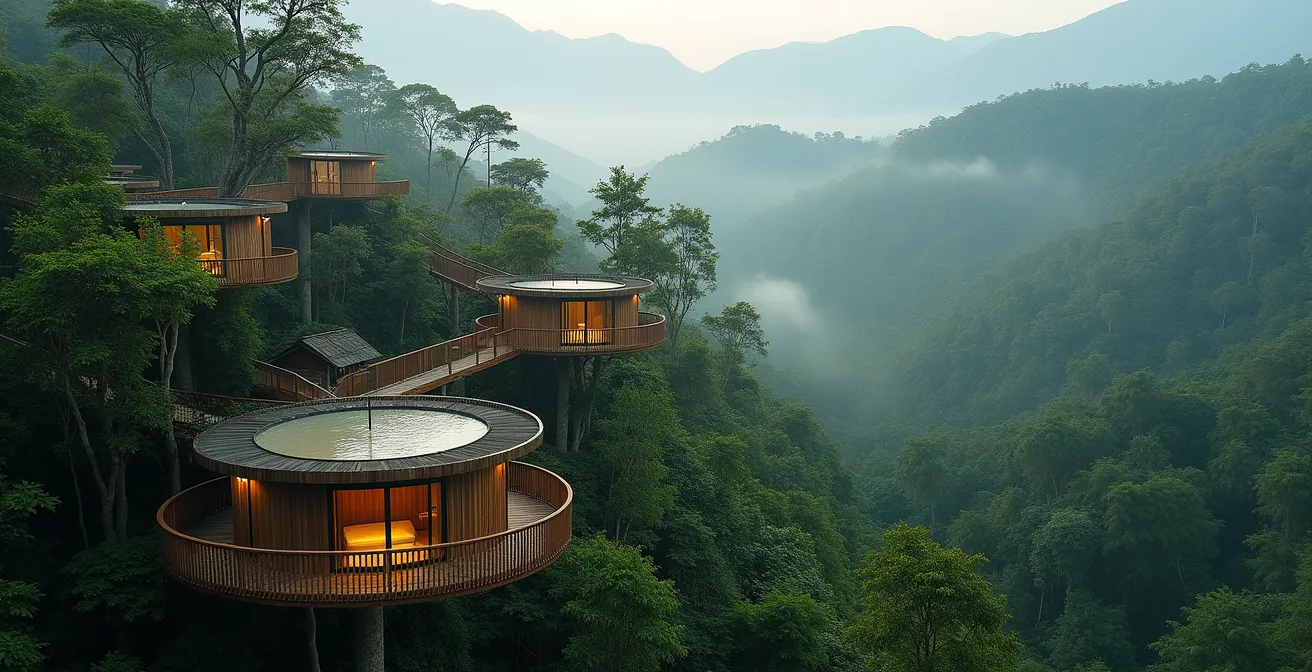
A true eco-lodge is a conservation finance model, not just a hotel with green features; its primary success metric is verifiable community and ecosystem support.
- Most tourism revenue is lost to “tourism leakage”; locally-owned lodges keep up to 90% of your money within the community, compared to as little as 20% for international chains.
- Superficial “green” claims, like using bamboo fabric, can hide toxic production processes that harm the environment, requiring deeper investigation.
Recommendation: Before booking, conduct your own due diligence using an auditor’s mindset to assess ownership, supply chains, and genuine conservation partnerships.
For the ethical traveler, the promise of an “eco-lodge” is intoxicating: a vacation that not only rejuvenates the soul but actively contributes to the preservation of a pristine environment. We’re drawn to images of thatched roofs nestled in lush canopies and declarations of commitment to sustainability. We diligently reuse our towels, skip the plastic straws, and feel we’re making a difference. But what if these visible, performative actions are merely a convenient distraction?
The common narrative around eco-tourism often stops at these surface-level gestures. It praises solar panels and recycling bins but rarely asks the tougher, more important questions. Where does the money actually go? Who owns the land? What is the real, measurable impact on the local economy and wildlife beyond the lodge’s fence? The uncomfortable truth is that many establishments leverage the “eco” label for marketing, while their operational structure does little to combat the core problems of environmental degradation and economic disparity.
This guide offers a paradigm shift. Instead of accepting green claims at face value, we will adopt the rigorous mindset of an auditor. The central thesis is this: a genuine eco-lodge operates not as a hospitality business with green features, but as a holistic conservation finance model. Your stay is an investment, and like any smart investor, you have the right to demand proof of returns—not for yourself, but for the community and ecosystem that hosts you. We will dissect the financial structures, question the marketing fluff, and provide a practical framework to distinguish true conservation partners from the greenwashers.
This article provides an investigative framework to help you analyze a lodge’s true commitment. By exploring the economic, environmental, and cultural dimensions of their operations, you will be equipped to make travel choices that generate a powerful, positive, and verifiable impact.
Summary: Beyond the Brochure: How to Verify if an Eco-Lodge Truly Supports Conservation
- Why Staying at Locally-Owned Lodges Keeps 3x More Money in the Community?
- How to Distinguish Legit Green Certifications from Marketing Fluff?
- Rainforest Lodge vs Marine Reserve: Which Conservation Effort Needs Your Support More?
- The “No Plastic Straws” Trap That Hides Massive Environmental Damage
- When to Visit Nesting Sites to Observe Without Disrupting the Animals?
- The Bamboo Fabric Lie: Why “Bamboo Viscose” Is Actually Toxic to Produce?
- The disrespectful Selfie Behavior That Can Get You Banned from Sacred Temples
- Why Private Electric Aviation Is the Future of Regional Business Travel?
Why Staying at Locally-Owned Lodges Keeps 3x More Money in the Community?
The single most critical factor in determining your travel’s positive impact is not the thread count of the organic cotton sheets, but a simple economic principle: tourism leakage. This term describes the phenomenon where money spent by tourists is “leaked” out of the host country’s economy and repatriated to the foreign headquarters of international corporations. It’s the invisible hole in the bucket of sustainable development, and its scale is staggering. For example, research shows that in most all-inclusive package tours, particularly in resort-heavy destinations like the Caribbean, as much as 80% of expenditures leave the country.
This is where the distinction between a locally-owned guesthouse and a foreign-owned luxury chain becomes stark. A locally-owned lodge is inherently more integrated into the community’s economic fabric. It sources food from local farmers, hires artisans for its decor, employs community members in management roles, and reinvests its profits locally. In contrast, an international resort often imports food, materials, and even management staff, sending the vast majority of its revenue offshore.
A compelling case study from Bali illustrates this divide perfectly. An analysis found that 5-star foreign-owned resorts in Bali result in 51% leakage, while non-star-rated, locally owned hotels see only 8.8% of revenue leave the local economy. Choosing a locally-owned establishment is not a matter of charity; it is the most effective financial strategy for ensuring your vacation funds directly support the people and place you’ve come to admire.
Your Audit Checklist: Assessing Local Economic Integration
- Ownership & Control: Investigate who owns the property. Is it a local family or an international conglomerate hiding behind a local name?
- Supply Chain Audit: Ask where the lodge sources its food, building materials, and amenities. Prioritize establishments that champion local suppliers over importers.
- Staffing Structure: Examine the staff roster. Are management and skilled positions held by locals, or are they reserved for expatriates, with community members in low-wage roles?
- Community Investment: Look for evidence of profit reinvestment. Does the lodge fund a local school, support a health clinic, or contribute to a community conservation fund?
- Transparency & Reporting: Check if the lodge publishes a transparency report detailing what percentage of its revenue and staff are local. A lack of data is often a red flag.
How to Distinguish Legit Green Certifications from Marketing Fluff?
In the quest for ethical travel, green certifications seem like a perfect shortcut. A small logo from the Rainforest Alliance, Green Globe, or B Corp on a lodge’s website appears to be a seal of approval, a third-party guarantee of its environmental and social credentials. However, the world of certifications is a complex and often misleading landscape. An auditor’s perspective requires you to look past the logo and investigate the rigor, relevance, and accessibility of these schemes.
Many certifications are costly and administratively burdensome, creating a barrier to entry for the very operations you might want to support. As the Storylines Travel Blog wisely notes, “It is more complex and expensive for some of the smaller eco-lodges to receive these certifications, so don’t be too quick to judge.” A small, family-run lodge deeply embedded in its community may practice profound sustainability without having the resources to pay for a mainstream certification. Conversely, a large, well-funded corporation can often “buy” a certification by ticking boxes on a checklist that may not address the most significant local issues.
This is where your investigative skills come in. Does the certification focus on meaningful metrics like water conservation in a drought-prone area, or does it award points for generic actions like having a written environmental policy? True sustainability is context-specific. A ‘one-size-fits-all’ global certification may fail to capture the nuances of a particular ecosystem or community.

The image of carefully examining a document serves as a powerful metaphor. Don’t just see the seal; investigate its substance. Look for certifications that are transparent about their criteria, conduct on-site audits, and are recognized by reputable conservation bodies. More importantly, view a lack of certification not as an immediate failure, but as a prompt to conduct your own audit based on the principles outlined in this guide.
Rainforest Lodge vs Marine Reserve: Which Conservation Effort Needs Your Support More?
The question isn’t about pitting one ecosystem against another, but about understanding the different conservation finance models your tourism dollars can support. The choice is less about “rainforest vs. reef” and more about “high-value, low-volume” versus “low-value, high-volume” tourism. The impact of your stay is directly tied to the economic model of the place you choose. Mass tourism, like that of cruise ships and large all-inclusive resorts, often has a devastatingly low per-tourist benefit to the local economy.
The numbers are telling. A study by the Adventure Travel Trade Association found that it takes 96 cruise tourists to generate the same $10,000 for a local economy that just four adventure travelers do. This is the power of a model built on deep engagement rather than fleeting visits. High-value eco-lodges, whether terrestrial or marine, are designed around this principle. They attract fewer guests who pay more, stay longer, and are more invested in the conservation mission, resulting in a smaller physical footprint and a larger financial contribution per person.
The following comparison, based on data from various conservation and tourism analyses, clarifies the different funding structures at play. It reveals how community-owned and luxury eco-lodge models are fundamentally geared toward local benefit and conservation, while mass tourism is not.
| Funding Model | Local Benefit Rate | Conservation Investment |
|---|---|---|
| Community-owned conservancies | ~76% stays local | Direct funding to protection |
| Luxury eco-lodges | ~60% to conservation/local economy | Significant global investment |
| Mass tourism resorts | ~20% stays local | Minimal conservation focus |
Ultimately, your support is most needed by operations that have an explicit, transparent, and effective model for converting tourism revenue into conservation action. Whether it’s a lodge funding anti-poaching patrols in a savanna or a dive resort financing coral reef restoration, the crucial element is the verifiable link between your payment and the protection of that specific ecosystem.
The “No Plastic Straws” Trap That Hides Massive Environmental Damage
The removal of plastic straws has become the poster child for corporate environmentalism. It’s a visible, easily understood action that makes consumers feel good. However, it’s also a perfect example of performative greenwashing—a small, token gesture that can distract from far greater, often hidden, environmental harms. An auditor must learn to look beyond these surface-level initiatives and investigate the lodge’s foundational impact on its environment.
The most significant environmental damage often occurs before the first guest even arrives. As the watchdog site Tourism vs Climate Change points out, “Many eco-lodges are built right into pristine environments, so first trees and plants need to be cut to create infrastructure.” The construction of roads, foundations, and buildings can cause irreversible habitat destruction, soil erosion, and disruption of local hydrology. A lodge that boasts about banning straws while having been built by clear-cutting a patch of primary forest is engaging in a profound deception.
A true eco-lodge’s commitment is measured not by the absence of a plastic straw but by the presence of a holistic system for minimizing its footprint. This includes its sources of water and energy, its methods of waste treatment, and the “food miles” of its restaurant. Does the lodge rely on a hidden diesel generator while showcasing a few decorative solar panels? Does it draw unsustainable amounts of water from a local aquifer, impacting nearby communities? Your audit must probe these operational fundamentals.
To move beyond the straw, consider these points for your investigation:
- Water & Wastewater: Where does the water come from, and where does it go? Look for rainwater harvesting, greywater recycling, and natural filtration systems instead of chemical treatments that pollute local waterways.
- Energy Source: Demand transparency on energy generation. A truly sustainable lodge will be proud to show you its solar array, micro-hydro system, or other renewable sources, not hide a noisy, polluting generator out of sight.
- Food Sourcing: Investigate the menu. Is it filled with imported ingredients, or does it champion local, seasonal produce, thereby reducing food miles and supporting local agriculture?
- Building Materials: Was the lodge built with locally and sustainably sourced materials, or did it rely on imported, carbon-intensive resources?
When to Visit Nesting Sites to Observe Without Disrupting the Animals?
The opportunity to witness wildlife in its natural habitat—sea turtles nesting, birds performing courtship rituals, or predators on the hunt—is a primary draw of eco-tourism. However, this proximity carries immense responsibility. The line between observation and disturbance is perilously thin. The ethical question is not just *if* you can see the animals, but *how* you do so without causing stress, altering their behavior, or endangering their survival. A truly conservation-focused lodge prioritizes the animals’ welfare over the guest’s viewing-satisfaction.
The best time to visit is always during a period and in a manner prescribed by wildlife biologists and local conservation experts. Reputable lodges work with these experts to establish strict guidelines: minimum viewing distances, the use of camouflage hides, bans on flash photography, and limitations on group sizes and visit durations. They understand that repeated, unregulated human presence can cause parent animals to abandon nests, disrupt mating cycles, and make prey more vulnerable.
Furthermore, leading eco-lodges are moving beyond simple observation and becoming hubs for conservation technology. The most advanced operations are not just places to stay; they are active field research stations.
Case Study: Non-Invasive Monitoring Technology
Modern luxury eco-lodges often serve as testing grounds for cutting-edge conservation technology. Instead of disruptive guided walks, they may use a network of sophisticated, non-invasive monitoring systems like camera traps, acoustic sensors, and drone surveillance (at a safe altitude). Guests can then experience the wildlife through high-quality footage and data presented by a resident biologist, getting a deeper scientific understanding without ever disturbing the animals. This model turns tourism into a direct funding mechanism for crucial wildlife research.

The goal is to observe without being perceived. Lodges that provide observation hides, use guides trained in animal behavior, and schedule tours to minimize impact demonstrate a genuine commitment to co-existence. They understand that the privilege of witnessing nature comes with the profound duty to protect it.
The Bamboo Fabric Lie: Why “Bamboo Viscose” Is Actually Toxic to Produce?
Bamboo is often marketed as a miracle plant for sustainability. It grows incredibly fast, requires little water, and needs no pesticides. So, when an eco-lodge proudly advertises its soft, silky bamboo sheets and towels, it seems like a clear win for the environment. This, however, is one of the most pervasive and misleading lies in the “green” materials industry. The problem isn’t the bamboo plant itself, but the highly toxic process used to turn its tough wood into soft fabric.
Most bamboo fabric on the market is technically “bamboo viscose” or “rayon.” This process involves dissolving the bamboo pulp in a cocktail of hazardous chemicals. As the green living hub The Eco Hub highlights, the environmental cost is immense, as studies reveal that about 50% of the hazardous waste from this production cannot be recaptured and is released into the environment. This pollutes waterways and harms ecosystems, completely negating the benefits of the raw material.
The human cost is just as severe. The chemicals used are dangerously corrosive and toxic. As the ethical brand Bears for Humanity explains in their research:
Carbon Disulfide is highly toxic and has been linked to severe health issues, including damage to the lungs and nervous system. Sodium Hydroxide and Sulfuric Acid are highly corrosive.
– Bears for Humanity, Setting the Record Straight – Bamboo Textiles
An auditor must question all material claims. Instead of “bamboo,” look for truly sustainable fabrics like organic cotton, linen (which can be made from bamboo mechanically, a much cleaner process), or Tencel™ Lyocell, which is produced in a “closed-loop” system that recycles over 99% of its non-toxic solvents. A lodge’s choice of textiles is a clear indicator of whether its sustainability commitment is genuine or just skin-deep.
The disrespectful Selfie Behavior That Can Get You Banned from Sacred Temples
A holistic audit of an eco-lodge extends beyond environmental and economic factors into the crucial domain of cultural sustainability. A responsible operation doesn’t just exist within a community; it actively respects, honors, and helps preserve its cultural heritage. The rise of social media has amplified a particularly damaging behavior: the disrespectful selfie. Tourists posing inappropriately at sacred sites, climbing on ancient statues, or treating solemn ceremonies as a backdrop for their profile pictures represent a profound failure of cultural respect.
This behavior is more than just a breach of etiquette; it can cause deep offense to the local community and, in many places, can lead to being fined or banned from sites. A true eco-lodge sees its role as a cultural bridge, not just a bed for the night. It has a responsibility to educate its guests on local customs, dress codes, and appropriate behavior before they venture out. This includes clear guidance on when and where photography is acceptable and explaining the significance of the sites they will visit.
The best lodges go further, integrating cultural preservation directly into their business model. They facilitate authentic, respectful interactions rather than transactional tourism. Instead of simply sending guests to a temple, they might partner with local elders or cultural guides who can share the stories and spiritual meaning of the place.
Case Study: Community-Led Cultural Tourism in Japan
Akizuno Garten in Tanabe, Japan, exemplifies a successful community-led green tourism project. Housed in a former elementary school, this venture was initiated by local residents to revitalize their rural area. It’s more than just accommodation; it’s a hub for agricultural experiences and cultural exchange that is owned and operated by the community itself. This model ensures that tourism serves to strengthen, not commodify, the local culture, and that respect is woven into the very fabric of the guest experience.
When you evaluate a lodge, look for this commitment to education and partnership. Do they provide clear guidelines on cultural etiquette? Do they employ local guides? Do they promote and support local artisans and cultural events in a way that is respectful and empowering? Your choice can either contribute to the erosion of a culture or help it thrive.
Key Takeaways
- Prioritize locally-owned lodges to combat “tourism leakage” and ensure your money directly supports the host community.
- Investigate beyond surface-level claims; question the validity of certifications and the sustainability of materials like “bamboo” fabric.
- Choose experiences that operate on a transparent conservation finance model, where your visit demonstrably funds wildlife protection and cultural preservation.
Why Private Electric Aviation Is the Future of Regional Business Travel?
While the title points to a futuristic and exciting solution for reducing travel’s carbon footprint—private electric aviation—the immediate, practical reality for today’s most committed eco-lodges lies closer to home. The largest single source of carbon emissions for any remote lodge is often not the guests’ flights, but the lodge’s own energy generation and supply chain. For an auditor, the most pressing question is: how is the lodge powered right now?
Many remote lodges, being off-grid, have historically relied on diesel generators. These are noisy, polluting, and dependent on a carbon-intensive supply chain to transport fuel. A forward-thinking eco-lodge’s primary energy goal is self-sufficiency through renewable sources. This is the current gold standard and a far more impactful and verifiable measure of sustainability than speculating about future travel technologies.
As hospitality technology experts at CiMSO explain, the most innovative lodges are pioneering on-site power generation, which is fundamental to their sustainable operation in remote locations.
Eco-lodges are increasingly turning to solar, wind, and hydroelectric power. Some lodges harness micro hydropower systems from nearby rivers to generate power. These efforts lower carbon emissions and ensure energy self-sufficiency in remote locations.
This move towards energy independence does more than just lower carbon emissions. It creates a more resilient operation, reduces operational costs in the long run, and completely eliminates the environmental damage associated with fuel transportation. When evaluating a lodge, look for extensive solar arrays, inquire about micro-hydro or wind systems, and ask for data on their percentage of renewable energy usage. A lodge that has invested heavily in its own clean power infrastructure is making a tangible, long-term commitment to reducing its environmental impact, a commitment far more meaningful than any future promise.
Your next step is not just to book a vacation, but to conduct your own due diligence. Use this framework to invest your travel funds in ventures that deliver verifiable conservation and community outcomes.
Frequently Asked Questions on Which Eco-Lodges Actually Contribute More than 50% to Local Conservation?
What’s the difference between bamboo viscose and bamboo lyocell?
Bamboo lyocell is a more sustainable alternative to viscose. It uses considerably less toxic chemicals and operates within a closed-loop system using N-methylmorpholine-N-oxide, an amine oxide solvent which can be reused repeatedly, minimizing waste.
Can bamboo fabric be truly sustainable?
Yes, when it is produced through mechanical processing rather than chemical processing. This method, similar to how linen is made from flax, creates a fabric known as bamboo linen and is the most sustainable way to produce bamboo textiles, avoiding the harsh chemicals of the viscose process.
What percentage of chemicals can be recovered in lyocell production?
The lyocell process is highly efficient. For example, the branded process for Tencel Lyocell can recapture and reuse over 99.5% of the chemicals used, making it an environmentally responsible choice for fabric production.