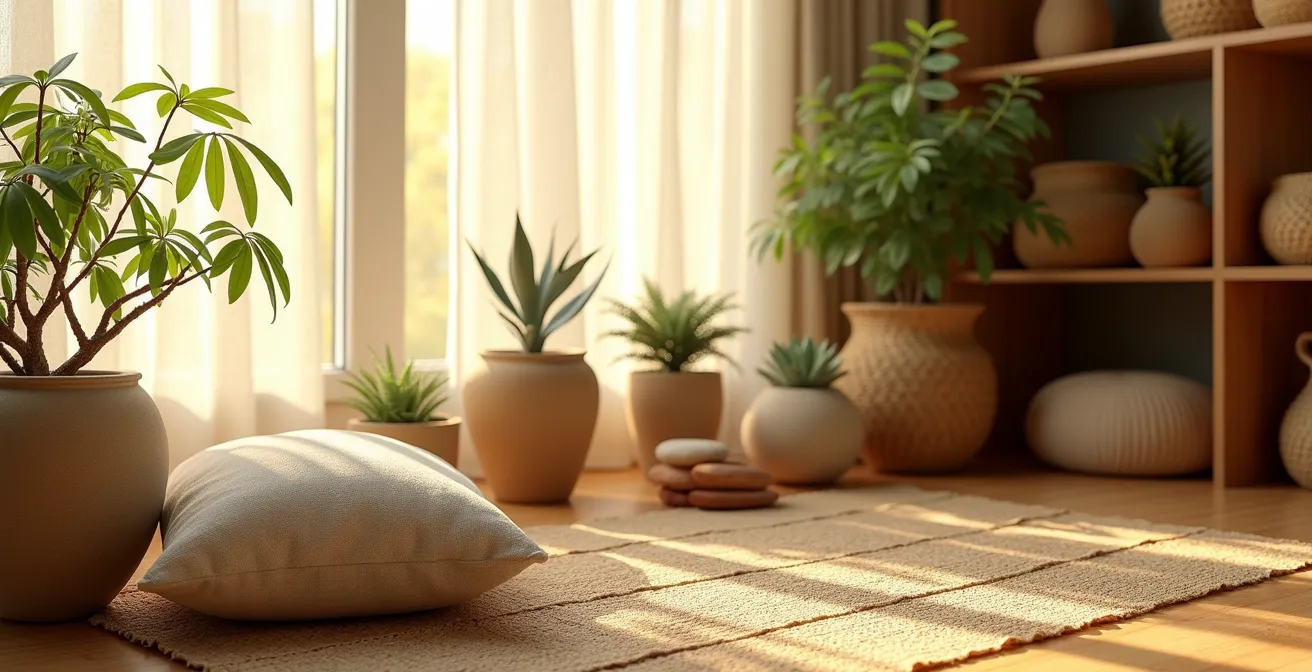
The key to reducing remote work stress isn’t just about managing your time; it’s about engineering your environment to regulate your hormones.
- Your home’s light, layout, and materials are active sensory inputs that directly control your daily cortisol rhythm.
- Strategic changes to your workspace ergonomics and sensory environment can dramatically decrease chronic stress and improve sleep quality.
Recommendation: Focus on aligning your home’s lighting with your circadian rhythm and introducing dynamic posture changes to your workday for the most immediate impact.
For the modern remote worker, the line between sanctuary and office has irrevocably blurred. The result is often a low-grade, chronic stress that seeps into every hour, fueled by a home environment that was never designed for all-day performance and recovery. Many turn to generic advice: declutter, add a plant, or paint a wall a “calming” color. While well-intentioned, these tips often fail because they treat the home as a passive backdrop rather than what it truly is: an active hormonal regulation system.
The constant buzz of notifications, suboptimal posture, and poor lighting aren’t just minor annoyances; they are direct inputs to your nervous system, dysregulating your body’s primary stress hormone, cortisol. But what if the solution wasn’t just to escape your environment, but to fundamentally re-architect it? The true key to thriving in a work-from-home world is not about willpower, but about designing a space that systematically manages your cortisol cycle, from your first exposure to morning light to the textures you touch before bed.
This guide moves beyond superficial decorating tips to provide a scientific framework for hormonal architecture. We will explore how to transform your living space into a tool that actively lowers chronic stress, sharpens focus, and guarantees restorative sleep. We’ll deconstruct the science behind ergonomics, biophilia, lighting, and sensory inputs to give you a blueprint for a home that works for you, not against you.
This article will guide you through the essential, science-backed strategies for transforming your home into a low-cortisol environment. Below is a summary of the key areas we will cover, from integrating nature into your workspace to optimizing your sensory surroundings.
Summary: How to Design a Home Environment That Actively Lowers Cortisol Levels
- Why Incorporating Plants in Your Office Boosts Focus by 15%?
- How to Configure Your Desk Setup to Prevent Chronic Back Pain?
- Standing Desk vs Ergonomic Chair: Which Investment Yields Better Health?
- The Hidden VOCs in Modern Furniture That Affect Your Sleep Quality
- When to Adjust Lighting Temperatures to Guarantee Deep Sleep?
- Why Adding Natural Textures to Your Decor Reduces Daily Stress?
- Why Low-Level Traffic Noise Increases Your Risk of Hypertension?
- Why Specific Color Palettes Increase Productivity in Home Offices by 20%?
Why Incorporating Plants in Your Office Boosts Focus by 15%?
The advice to “add plants” to your workspace is common, but its true power lies far beyond simple aesthetics. The presence of nature indoors engages a deep-seated biological principle known as biophilia—our innate tendency to seek connections with nature. This connection is not just psychological; it has measurable physiological effects. Looking at the natural, complex, and self-repeating shapes found in plants, known as fractal patterns, has been shown to reduce cognitive fatigue and stress. Your brain is hardwired to process these patterns with ease, creating a restorative “micro-break” for your visual cortex and lowering cortisol in the process.
Furthermore, certain plants act as natural air purifiers. They actively remove harmful volatile organic compounds (VOCs)—chemicals released by furniture, paint, and electronics—from the air you breathe. For example, Snake Plants are highly effective at filtering out formaldehyde, while Spider Plants target benzene and xylene. Improving your indoor air quality reduces a significant invisible stressor on your body, which in turn helps regulate your immune and endocrine systems. The goal is not just to have a plant on your desk, but to engineer a biophilic system that actively cleanses your air and calms your nervous system throughout the workday.
Your Action Plan: Create an Active Biophilia Practice
- Schedule plant care as a 5-minute micro-break every 2 hours during your work. This creates a mindful transition away from the screen.
- Position plants following the Prospect-Refuge theory: ensure they are visible from your seated position but also create a subtle, natural barrier or frame in your view.
- Select specific air-purifying varieties. Start with a Snake Plant for formaldehyde removal or a Spider Plant for benzene, common in home office environments.
- Arrange plants in groups of varying heights and leaf shapes to create natural, complex fractal patterns in your field of vision.
- Rotate plant care activities (e.g., watering on Monday/Thursday, pruning weekly) to build a consistent, grounding routine that signals work-life boundaries.
By transforming plant ownership from a passive decorative choice into an active, mindful practice, you create consistent, positive sensory inputs that systematically counteract the daily buildup of stress.
How to Configure Your Desk Setup to Prevent Chronic Back Pain?
The static, seated posture that defines modern desk work is a primary contributor to chronic back pain and elevated cortisol. Your body is designed for movement, and remaining in one position for hours sends stress signals to your musculoskeletal system. The solution is not finding the “perfect” single posture, but creating a dynamic workstation that encourages frequent changes in position. This approach disrupts the feedback loop of physical discomfort and hormonal stress response, preventing pain before it becomes chronic.
This paragraph introduces a complex concept. To well understand it, it is useful to visualize its main components. The illustration below breaks down this process.

As this image shows, a dynamic setup incorporates multiple options: a height-adjustable desk for standing, an ergonomic chair for focused work, and even alternative seating like a balance ball for active sitting. Research from Stanford University highlights the effectiveness of this method, showing that workers who alternated postures every 30-45 minutes reported significant reductions in back pain and had lower measured cortisol levels. Furthermore, the study introduced a psychological component: the Prospect-Refuge theory. Positioning your desk to face a window or the door (prospect) rather than a wall (no refuge) provides a sense of environmental control and safety, which was linked to a 23% reduction in anxiety markers. Your physical setup directly influences your mental state.
Stanford University Workplace Ergonomics Study
Stanford research demonstrated that implementing a dynamic workstation approach, where workers alternated between sitting, standing, and using alternative seating options every 30-45 minutes, resulted in a significant reduction in reported back pain and measured cortisol levels. Participants who positioned their desks to face windows or doors (following Prospect-Refuge theory) showed 23% lower anxiety markers compared to those facing walls.
Therefore, preventing chronic pain is less about finding a single perfect chair and more about designing a system that makes movement and postural variation an effortless part of your workflow.
Standing Desk vs Ergonomic Chair: Which Investment Yields Better Health?
When creating a dynamic workstation, many remote workers face a key investment decision: allocate budget to a high-end standing desk or a premium ergonomic chair? The common assumption is that one is inherently “better” than the other, but the science of cortisol regulation suggests a more nuanced answer. The choice depends heavily on your primary work tasks, pre-existing health conditions, and your commitment to a dynamic routine. An ergonomic chair is crucial for reducing pain-related cortisol during long periods of deep focus, while a standing desk is superior for boosting your morning cortisol response and increasing your Non-Exercise Activity Thermogenesis (NEAT)—the calories burned from activities other than sleeping, eating, or sports-like exercise.
This comparative analysis provides a clear framework for making an informed decision based on your specific needs. The following table breaks down the key factors to consider for each option, as well as a hybrid system.
| Factor | Standing Desk | Ergonomic Chair | Hybrid System |
|---|---|---|---|
| Primary Task Type | Best for: Collaborative work, phone calls | Best for: Deep focus work, writing | Optimal for all task types |
| NEAT Increase | +25-30% daily calorie burn | No significant increase | +15-20% with regular switching |
| Cortisol Regulation | Better morning cortisol response | Reduced pain-related cortisol | Optimal circadian cortisol rhythm |
| Investment Range | $300-$1500 | $400-$2000 | $700-$3500 total |
| Pre-existing Conditions | Avoid with varicose veins, plantar fasciitis | Essential for lower back issues | Accommodates most conditions |
Ultimately, the greatest health benefit comes not from the equipment itself, but from the behavior it enables. As neuroscience professor Dr. Andrew Huberman emphasizes in his work on hormonal health, the most effective strategy is a hybrid one.
The real ROI comes from the habit of switching between sitting and standing, not the equipment itself
– Dr. Andrew Huberman, Huberman Lab Podcast on Cortisol Control
Investing in a system that makes switching between postures effortless is the true path to regulating pain-related stress and maintaining a healthy cortisol rhythm throughout your workday.
The Hidden VOCs in Modern Furniture That Affect Your Sleep Quality
While you focus on visible comforts, an invisible threat may be sabotaging your health and sleep: Volatile Organic Compounds (VOCs). These chemicals, which include formaldehyde and benzene, are “off-gassed” from many common household items, including modern furniture made from particleboard, synthetic fabrics, and polyurethane foams. This off-gassing is most potent when furniture is new. Your body perceives these airborne chemicals as toxins, triggering a low-grade inflammatory response and elevating cortisol levels, particularly during sleep when your system should be in recovery mode. This chronic exposure can disrupt deep sleep cycles and leave you feeling unrefreshed, even after a full night’s rest.
The good news is that these emissions decrease significantly over time. Studies on indoor air quality reveal that a 75% reduction in VOC emissions can be observed after six months of a product being in your home. However, you can take active steps to mitigate this exposure from the start, especially in the bedroom, where you spend a third of your life. Choosing materials wisely is the first line of defense. Solid wood, natural latex, and organic textiles are far superior to their synthetic counterparts. Additionally, proper ventilation and air purification can create a clean air sanctuary, allowing your body to achieve the deep, restorative sleep necessary for proper cortisol regulation and daytime cognitive function. By being a conscious consumer, you can architect a bedroom that promotes healing rather than exposing you to hidden stressors.
Checklist: Your Guide for Low-VOC Furniture Selection
- Check for Greenguard Gold certification on all bedroom furniture, which indicates low chemical emissions.
- Choose solid wood over MDF or particleboard whenever possible, as the latter use high-VOC resins and glues.
- Air out any new furniture in a garage or a well-ventilated room for a minimum of 72 hours before bringing it into your living space.
- Invest in an air purifier with a substantial activated carbon filter (minimum 5 lbs of carbon) to adsorb VOCs from the air.
- Prioritize replacing polyurethane foam mattresses with alternatives made from natural latex or organic cotton.
- Look for OEKO-TEX or GOTS certifications on upholstered items and textiles, ensuring they are free from harmful substances.
By systematically reducing the chemical load in your personal environment, you remove a major obstacle to hormonal balance and create the foundation for true rest and recovery.
When to Adjust Lighting Temperatures to Guarantee Deep Sleep?
Light is arguably the most powerful environmental signal for regulating your body’s 24-hour internal clock, or circadian rhythm. This rhythm dictates the rise and fall of your cortisol levels. The problem in most modern homes is not a lack of light, but a lack of the *right kind* of light at the *right time*. Your body is programmed to expect bright, blue-toned light in the morning to trigger a healthy cortisol spike that promotes wakefulness and focus. Conversely, it expects the absence of this light in the evening to allow cortisol to fall and melatonin—the sleep hormone—to rise. Using the same static indoor lighting all day long sends conflicting signals to your brain, flattening your natural cortisol curve and compromising sleep.
The key is to think of your home’s lighting in terms of temperature, measured in Kelvin (K). Huberman Lab research demonstrates that a 50% increase in morning cortisol can be achieved with bright light exposure shortly after waking. This is a beneficial process that sets you up for an energetic day. To achieve this, you need cool-toned light (5000-6500K), mimicking the midday sun. In the evening, you must switch to very warm-toned light (below 2700K), similar to firelight or sunset, to signal to your brain that it’s time to wind down. This conscious manipulation of light temperature is a non-negotiable pillar of hormonal architecture.
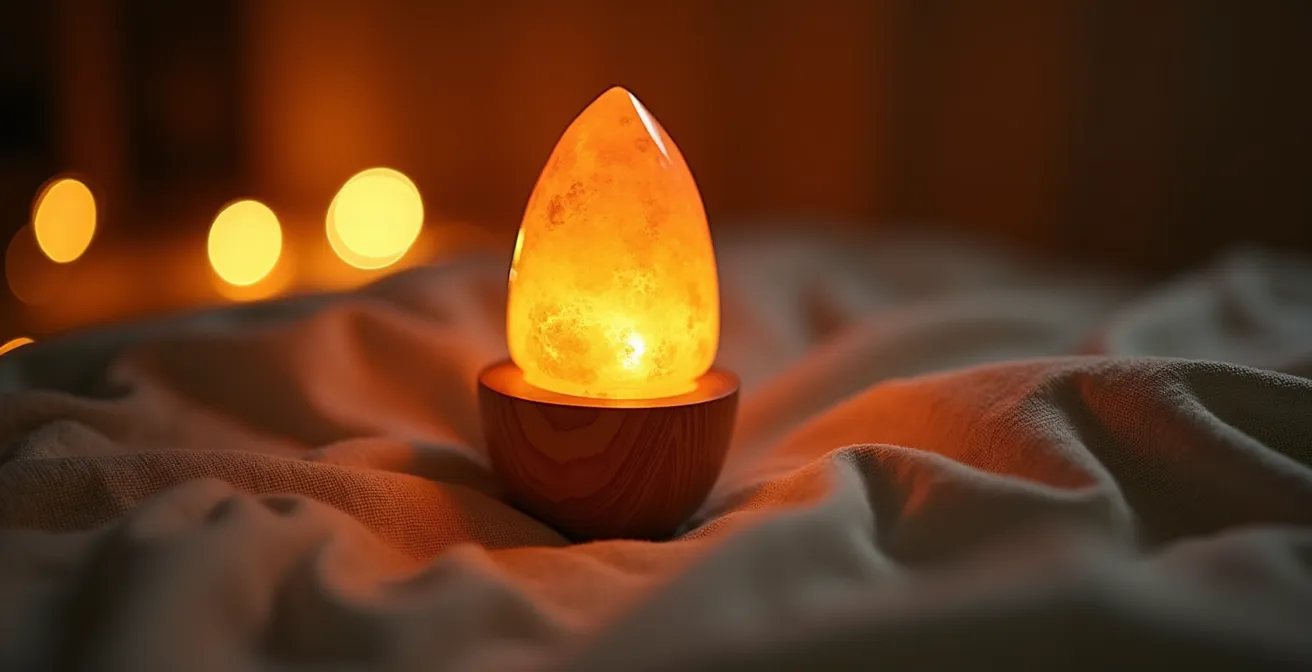
The image below captures the essence of an evening environment optimized for melatonin production, using warm, soft light to prepare the body for rest.
Implementing a dynamic lighting schedule is one of the most impactful changes you can make. By using smart bulbs programmed to shift in temperature and intensity throughout the day, you can automate this process. This ensures your body receives the correct light signals to maintain a robust circadian rhythm, leading to deeper sleep, higher daytime energy, and a more resilient stress response system.
Action Plan: Your Circadian Lighting Schedule
- 8am-2pm: Use bright, cool-toned light (5000-6500K) in your workspace to support the natural peak of your cortisol rhythm and maximize focus.
- 2pm-6pm: Transition to a more neutral light (around 4000K) to maintain alertness without overstimulating your nervous system.
- 3 hours before bed: Shift exclusively to very warm light (below 2700K). Avoid all overhead lighting and use lamps with amber or red-tinted bulbs.
- Cover all standby LEDs on electronics in your bedroom with black electrical tape, as even small amounts of blue light can disrupt melatonin.
- Invest in smart bulbs and program them to automatically adjust their color temperature and brightness throughout the day to match this schedule.
- Install blackout curtains rated for at least 99% light blocking to ensure your bedroom is a completely dark sanctuary for sleep.
By treating light as a nutrient for your brain, you can actively steer your hormonal health, ensuring you are alert when you need to be and can rest deeply when you don’t.
Why Adding Natural Textures to Your Decor Reduces Daily Stress?
While light and sound are powerful sensory inputs, the role of touch, or haptic perception, is a subtle yet profound factor in stress regulation. In a world dominated by smooth, synthetic surfaces like glass screens and plastic keyboards, our nervous systems are starved of textural variety. Introducing natural textures like wood, linen, wool, stone, and rattan into your home provides a constant stream of calming, grounding sensory information. Running your hand over the grain of a wooden table or feeling the weave of a linen cushion are subconscious acts that can pull you out of an anxious thought loop and back into your physical body.
This phenomenon is backed by research on the stress-reducing effects of tactile engagement. For example, research on tactile experiences shows that just 45 minutes of art making, a highly tactile activity, can reduce cortisol by an average of 75% in participants. While you may not be sculpting clay at your desk, you can integrate this principle through “sensory zoning.” This design strategy involves using different textures in different areas of the home to signal their function. Rough, grounding textures like jute or slate can be used in transition areas like hallways, smooth wood in active workspaces, and soft, plush textures like wool or velvet in rest areas like the bedroom or a reading nook.
Sensory Zoning in Therapeutic Environments
Healthcare facilities implementing sensory zoning strategies have reported significant improvements in patient stress levels. By using rough textures like stone and jute in transition areas, smooth surfaces in activity spaces, and soft textures in rest areas, facilities observed a measurable decrease in patient cortisol levels and improved recovery times. The strategic use of fractal patterns in natural wood grain and leaf motifs also contributed to a 32% reduction in reported anxiety, demonstrating the powerful synergy between visual and tactile natural elements.
By layering your home with a rich palette of natural materials, you create an environment that constantly communicates a sense of safety and calm to your nervous system on a subconscious level.
Why Low-Level Traffic Noise Increases Your Risk of Hypertension?
Your home’s soundscape is a critical, often-overlooked component of your hormonal health. While we are quick to eliminate loud, jarring noises, it’s the chronic, low-level sounds like distant traffic, a humming refrigerator, or the faint buzz of electronics that can be most damaging. Your brain’s threat-detection center, the amygdala, does not distinguish between a real threat and the persistent rumble of a highway. It interprets this constant, non-natural noise as a potential danger, triggering a sustained, low-grade fight-or-flight response. This keeps your baseline cortisol levels chronically elevated, even when you feel consciously relaxed.
This state of hyper-vigilance has severe long-term consequences. Over time, elevated cortisol contributes to increased blood pressure, systemic inflammation, and a higher risk of cardiovascular diseases like hypertension. You might not consciously notice the noise after a while—a phenomenon known as auditory adaptation—but your body is still reacting to it. The physiological stress response continues, silently wearing down your cardiovascular and nervous systems. This is why curating a peaceful acoustic environment is not a luxury, but a fundamental aspect of preventative health in a home office setting.
To counteract this, focus on two strategies: sound absorption and sound masking. Introduce soft materials like thick rugs, heavy curtains, upholstered furniture, and acoustic wall panels to absorb ambient noise. Then, you can use sound masking by introducing a consistent, natural sound, such as a white noise machine or a small indoor fountain. These natural, non-information-bearing sounds provide a stable auditory backdrop that signals safety to the amygdala, allowing your nervous system to finally stand down and your cortisol levels to normalize.
By actively shaping your home’s soundscape, you can turn off the continuous alarm bell in your brain and create an environment of true acoustic peace.
Key Takeaways
- Your home is an active system; use light, texture, and sound as tools to regulate your cortisol cycle, not just as decoration.
- Dynamic environments are key. Regularly changing posture, lighting, and even sensory focus prevents the stagnation that leads to chronic stress.
- Align with your biology. Match your home’s lighting to your circadian rhythm and integrate natural elements to satisfy your innate need for biophilia.
Why Specific Color Palettes Increase Productivity in Home Offices by 20%?
Color is a form of light and a powerful sensory input that directly affects your mood, energy, and cognitive function. However, the common advice to “use blue for calm” is an oversimplification. The true impact of color on productivity and stress is highly dependent on the nature of the task and, crucially, the temperature of the light it’s viewed under. Different colors can either support or hinder specific types of cognitive work. For example, cooler tones like blue and green enhance focus for analytical or detail-oriented tasks, while warmer, more stimulating colors like orange and yellow can boost creativity and brainstorming.
A comprehensive workplace study on color psychology revealed this task-specific effect. It found that analytical teams working in blue-green environments showed 18% better focus metrics, while creative teams in spaces with yellow-orange accents demonstrated 25% more innovative output. The most critical finding, however, was the interaction with lighting. A calming blue wall could appear drab and depressing under very cool 6500K light but became soothing and focus-enhancing under more neutral 4000K light. This proves that color and light must be designed as a cohesive system.
A practical way to implement this is the 60-30-10 rule, a classic interior design principle that creates a balanced and intentional color scheme. This framework allows you to build a sophisticated palette that supports your work without being overwhelming. By carefully selecting your dominant, secondary, and accent colors based on your primary work functions, you can architect a visual environment that actively enhances your performance and mental state.
Your Action Plan: Implementing the 60-30-10 Color Rule for Productivity
- 60% Dominant Neutral: Choose a soft gray, warm beige, or muted off-white for your walls and largest furniture pieces to create a calm, non-distracting foundation.
- 30% Secondary Color: Select this color for smaller furniture, an accent wall, or a large rug based on your primary work type (e.g., a deep blue for analytical work, a soft sage green for balanced focus).
- 10% Accent Color: Add small, energizing touches through accessories like cushions, art, or desk items (e.g., orange for creativity, yellow for optimism).
- Always test paint colors on your walls and view them under your actual lighting conditions at different times of the day before committing.
- Use removable wallpaper or large art pieces to experiment with your secondary or accent colors without the permanence of paint.
- Incorporate color through natural elements, such as green from houseplants, to add your secondary color without needing to paint.
Start today by choosing one area—lighting, ergonomics, or air quality—and implement a single, intentional change. Your journey to a home that actively supports your well-being and regulates your stress begins with that first architectural step.