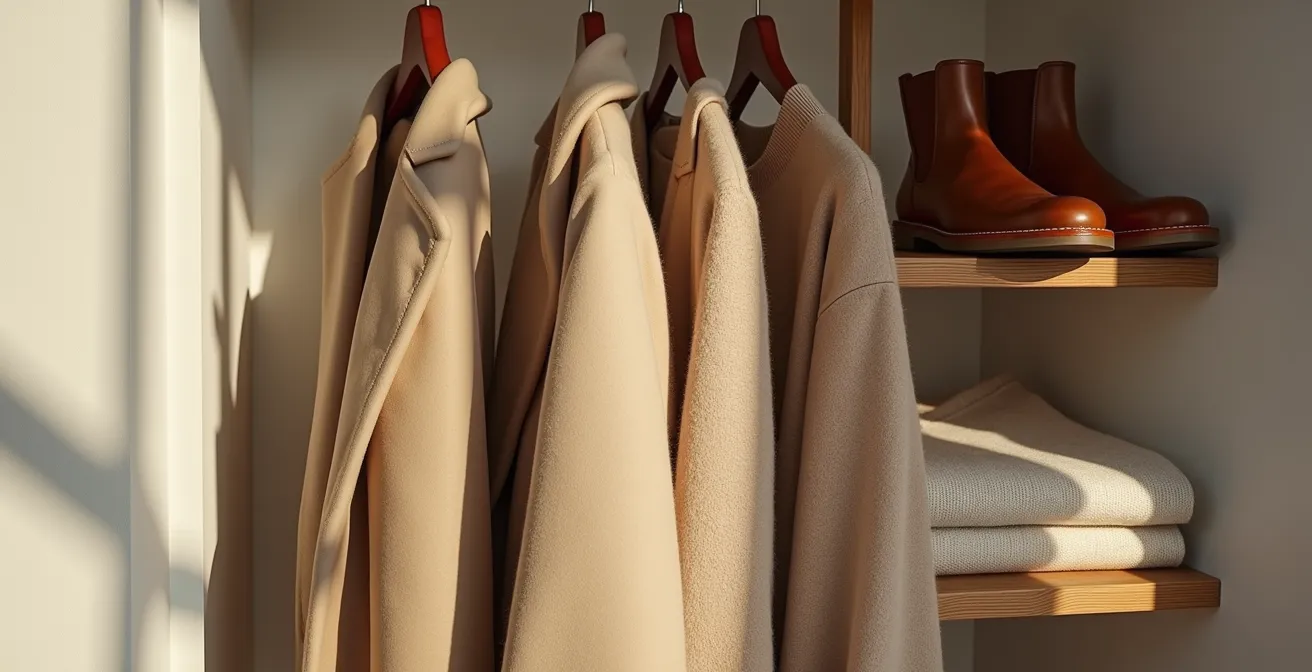
The secret to a lasting capsule wardrobe isn’t a magic number of items, but a shift in mindset from consumer to conscious investor.
- Focus on the “Cost-Per-Wear” formula to understand the true value of an item, proving a quality piece is often cheaper long-term.
- Master “Ethical Due Diligence” to look beyond surface-level claims and verify a brand’s commitment to animal welfare and sustainability.
Recommendation: Begin by auditing one category—like shoes—not just for style, but for true “Material Integrity” to see if “vegan” truly means “eco-friendly.”
The paradox of the modern closet is a familiar one: it’s overflowing, yet you have nothing to wear. This cycle of impulse buys, fleeting trends, and subsequent regret is the engine of fast fashion, leaving you with a wardrobe that feels disposable and misaligned with your values. The common advice is to declutter, create a shopping list of “timeless basics,” and stick to a neutral color palette. While well-intentioned, this approach often misses the fundamental point.
Building a wardrobe that endures for five years or more without looking dated is not about following a prescriptive list. It requires a deeper shift in perspective. What if the key wasn’t a specific trench coat, but the ability to recognize its enduring silhouette? What if the real secret wasn’t the price tag, but a simple mathematical formula that reveals an item’s true long-term cost? A truly sustainable and stylish wardrobe is built on a foundation of critical thinking, not just a collection of clothes.
This guide moves beyond the checklist. It equips you with the mental models to become a curator of your own style. We will deconstruct the concepts of value, analyze the language of ethics, and explore the psychology behind consumption. By mastering these principles, you will learn to build a small, powerful wardrobe where every single piece is a deliberate investment in your personal style, your wallet, and the planet.
To navigate this new approach, we will explore the essential frameworks for making conscious fashion choices. This article breaks down the key decision-making pillars that will empower you to build a wardrobe that is not only stylish and lasting but also a true reflection of your principles.
Summary: How to Build a Capsule Wardrobe That Lasts 5 Years Without Looking Dated?
- Cruelty-Free vs Vegan: Why Synthetic Shoes Might Not Be Eco-Friendly?
- How to Spot a “Trend” Shape vs a “Classic” Shape in Coats?
- Mulesing-Free Wool: How to Check the Tag for Animal Welfare?
- The Mathematical Formula to Prove a $200 Shirt Is Cheaper Than a $20 One
- How to Resist the Dopamine Hit of “New In” Emails?
- Why Staying at Locally-Owned Lodges Keeps 3x More Money in the Community?
- When to Apply the “One In, One Out” Rule to Maintain Your Wardrobe?
- How to Verify the Ethical Supply Chain of a $2,000 Handbag Before Buying?
Cruelty-Free vs Vegan: Why Synthetic Shoes Might Not Be Eco-Friendly?
In the quest for an ethical wardrobe, the terms “vegan” and “cruelty-free” are often used interchangeably, but they represent vastly different realities, especially concerning footwear. A “vegan” label simply means a product contains no animal-derived materials. However, many vegan leathers are made from synthetics like Polyvinyl Chloride (PVC) or Polyurethane (PU)—plastics derived from fossil fuels. This creates a paradox: a shoe can be “vegan” while having a significant environmental footprint. The fashion industry’s reliance on these materials is a major contributor to its environmental impact; some projections show the apparel industry alone could generate 1.2 billion metric tons of CO2e by 2030.
The solution is to look beyond the label and practice evaluating a material’s complete lifecycle. This means considering not just its origin but also its production process and end-of-life. This concept of material integrity is central to building a truly sustainable wardrobe. Innovative bio-materials like leather made from mushrooms, apples, or pineapples are emerging, but even these require scrutiny. Some may be bonded with plastics to improve durability, compromising their biodegradability. A conscious consumer must ask harder questions: Is this material designed to last? And what happens to it when I’m done with it?
Your Action Plan: Evaluating Eco-Friendly Shoe Materials
- Assess Recycled Content: Check for the percentage of recycled materials used. Be aware that currently, only a tiny fraction of textile resources globally come from recycling, so high percentages are a strong positive signal.
- Look for Biodegradability: For new bio-materials, seek out certifications that confirm they can biodegrade in home or industrial compost environments, ensuring they don’t end up as long-term waste.
- Investigate Energy Sources: Research the brand’s manufacturing processes. Many textile facilities, particularly for synthetics, are powered by coal, significantly increasing the product’s carbon footprint.
- Calculate Long-Term Impact: Weigh the cost-per-wear and expected lifespan against the environmental impact. A durable, repairable leather shoe may have a lower overall impact than a synthetic one that needs frequent replacement.
- Demand End-of-Life Solutions: Ask brands directly what their plans are for their products after use. Do they offer take-back programs or guidance on proper disposal and recycling?
How to Spot a “Trend” Shape vs a “Classic” Shape in Coats?
A capsule wardrobe is a collection of a few essential items of clothing that do not go out of fashion, such as skirts, trousers, and coats.
– Susie Faux, Wikipedia – Capsule Wardrobe Definition
Susie Faux’s original concept hinges on items that “do not go out of fashion,” a principle most tested in outerwear. Coats are investment pieces, yet they are also highly susceptible to fleeting trends. The key to choosing a coat that will last five years or more lies in understanding silhouette architecture—the underlying structure and proportion of a garment, separate from its color or detailing. Trends often manifest as exaggerations: extremely oversized shoulders, dramatically wide lapels, cropped hemlines, or asymmetrical closures. These elements are designed to create a novel, eye-catching shape for a single season.
A classic silhouette, by contrast, is defined by balance and proportion that complements the human form. Look for shoulders that align with your own, lapels that are moderate in width, and a length that is versatile (e.g., hitting at the knee or mid-thigh). A timeless coat, like a well-designed building, has a solid, logical structure. Its lines are clean and its form serves a function—providing warmth and a flattering shape without screaming for attention. By learning to analyze the garment’s bone structure, you can immunize yourself against the lure of seasonal trends and invest in a piece that will remain relevant for years.
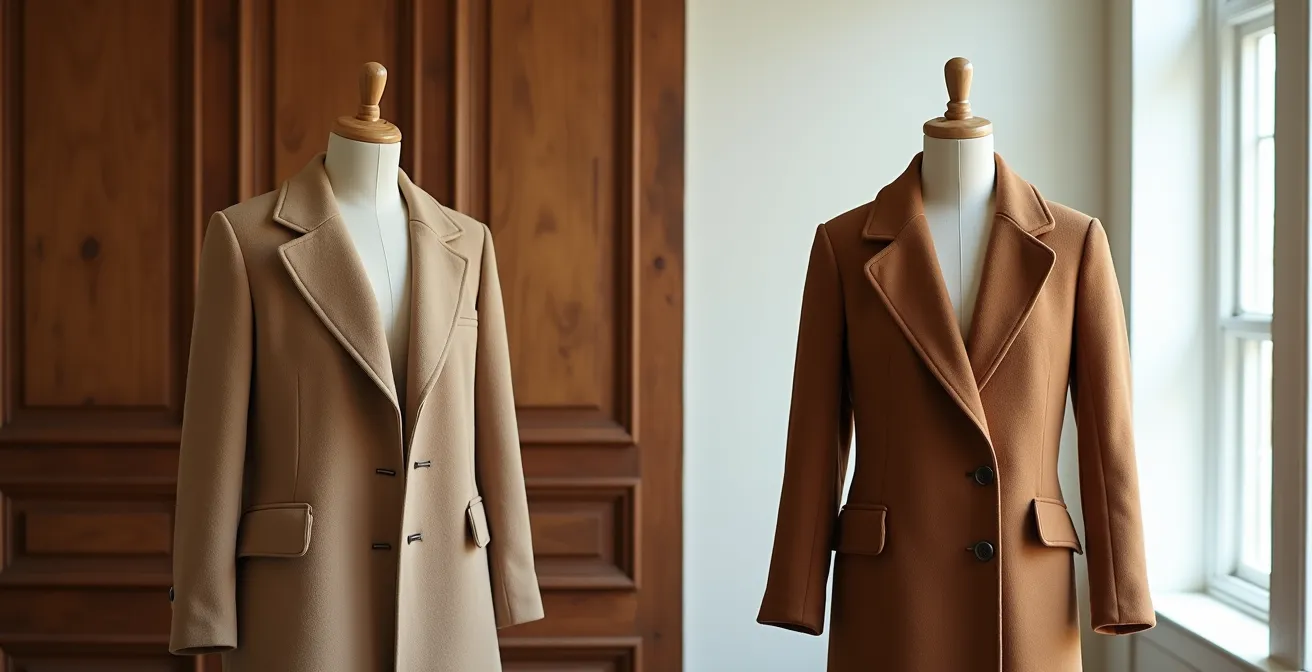
This visual distinction is critical. The classic form on the left is defined by its balanced proportions and natural drape, while the trendy form on the right relies on exaggeration for impact. The former is an investment in style; the latter is a short-term rental of a trend. When in doubt, always favor the silhouette that feels harmonious and understated over the one that feels theatrical.
Mulesing-Free Wool: How to Check the Tag for Animal Welfare?
For those who choose to include animal fibers in their wardrobe, wool is a prized material for its durability, breathability, and warmth. However, its production can be fraught with ethical issues, the most prominent being mulesing. This painful surgical procedure is performed on Merino sheep to prevent flystrike. As a conscious consumer, verifying that your wool is “mulesing-free” is a crucial first step in ethical due diligence. But the world of certifications can be confusing, with varying levels of rigor and transparency.
Simply seeing “Mulesing-Free” on a tag is a good start, but it’s often a self-declared claim by the brand with no third-party verification. To ensure true accountability, you must look for robust, audited certification standards. These standards not only address mulesing but also encompass a broader range of welfare conditions, land management, and supply chain transparency. Understanding the hierarchy of these certifications allows you to quickly assess the level of ethical commitment behind a garment, moving from basic claims to comprehensive, farm-level accountability.
The following table breaks down the common tiers of wool certification, providing a clear guide for what to look for on a product tag or brand’s website. It helps you differentiate between a simple marketing claim and a verifiable commitment to animal welfare.
| Certification Level | Standards | Third-Party Audit | Environmental Scope |
|---|---|---|---|
| Good: Mulesing-Free Claim | Basic animal welfare claim | No verification required | None |
| Better: RWS (Responsible Wool Standard) | Animal welfare standards | Yes – annual audits | Limited |
| Best: ZQ Merino/GOTS | Comprehensive welfare + sustainability | Yes – strict monitoring | Full supply chain |
Ultimately, a brand truly committed to transparency will make it easy for you to find this information. Look for QR codes on tags that lead to supply chain reports or dedicated sustainability pages on their website that name the specific farms they source from. This level of detail is the hallmark of a brand that has integrated ethics into its business, rather than just its marketing.
The Mathematical Formula to Prove a $200 Shirt Is Cheaper Than a $20 One
The most common barrier to building a sustainable wardrobe is the upfront cost of quality pieces. A $200 shirt can feel like an indulgence compared to a $20 alternative. However, this thinking ignores the most important metric for a capsule wardrobe: Cost Per Wear (CPW). This simple formula completely reframes the concept of value. Fast fashion’s business model relies on low initial prices to encourage high-volume, frequent purchases. In fact, a foundational McKinsey study found that in the 15 years prior to their report, 60% more garments were bought by the average person, but they were kept for only half as long.
The CPW formula is calculated as: CPW = Total Price of Item / Number of Times Worn. Let’s apply this. The $20 shirt, made with cheaper materials and weaker construction, might only last 10 wears before it pills, fades, or loses its shape. Its CPW is $20 / 10 = $2.00 per wear. The $200 shirt, crafted from superior fabric with reinforced seams, could be worn 200 times over five years. Its CPW is $200 / 200 = $1.00 per wear. The “expensive” shirt is, in reality, twice as cheap.
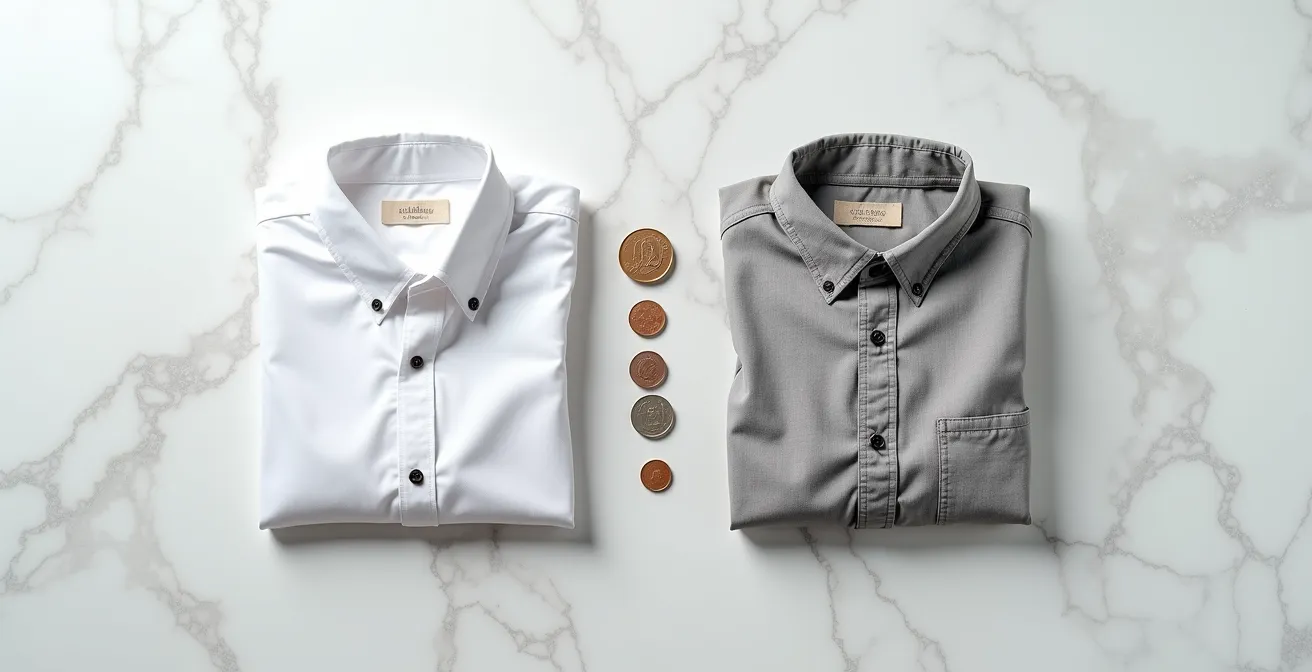
Case Study: Total Cost of Ownership Analysis
The blog Modern Minimalism provides a compelling analysis through its community. Readers who transitioned from fast fashion to a quality-focused capsule wardrobe consistently reported significant long-term savings. By tracking their spending, they demonstrated that the higher initial investment in fewer, better pieces drastically reduced their overall annual clothing expenditure by eliminating the constant need for replacement and impulse shopping.
This calculation transforms you from a passive consumer into a strategic investor. You stop asking “How much does this cost?” and start asking “What is the return on this investment?” It forces you to prioritize durability, timeless design, and quality craftsmanship, the very pillars of a wardrobe that lasts.
How to Resist the Dopamine Hit of “New In” Emails?
Building a capsule wardrobe is as much a psychological challenge as it is a logistical one. Fast fashion brands are masters of neuromarketing, using “New In” emails, limited-time offers, and constant novelty to trigger a dopamine response in our brains. This chemical reward creates a powerful, often subconscious, urge to buy, making us feel that acquiring something new is the solution to boredom or dissatisfaction. Resisting this requires more than just willpower; it requires a conscious strategy for a digital dopamine detox.
The first step is to create friction. Marketing works best when it’s seamless. By unsubscribing from retail email lists and unfollowing fast-fashion accounts on social media, you erect a barrier between the trigger and the response. This gives your rational brain a moment to catch up with your impulsive brain. The next step is to replace the habit. When you feel the urge to browse online, have an alternative, rewarding activity ready. This could be curating outfits from your existing closet, listening to a favorite playlist, or transferring the money you would have spent into a savings account, creating a different kind of positive reinforcement.
There is nothing you can buy that will finally make you not want anything. The secret to having it all is recognizing you already do.
– Courtney Carver, Be More With Less
This insight from Courtney Carver, creator of the Project 333 capsule wardrobe challenge, is the ultimate goal. The detox process is about rewiring your brain to find joy and creativity within the boundaries of what you own, rather than constantly seeking it from an external purchase. It’s about shifting your source of satisfaction from acquisition to appreciation.
- Unsubscribe immediately from all retail email lists to remove the primary trigger.
- Use a closet-organizing app to “shop your own closet” and rediscover forgotten combinations when you feel the urge to buy.
- Create a 10-song “craving” playlist to listen to as a pattern interrupt instead of opening a shopping app.
- Set up an automatic transfer to your savings account for a fixed amount every time you successfully resist a non-essential purchase.
- Actively deconstruct marketing emails you happen to see, identifying the persuasion tactics (scarcity, social proof) to build conscious awareness.
Why Staying at Locally-Owned Lodges Keeps 3x More Money in the Community?
While this principle originates in the world of sustainable travel, its core logic offers a powerful parallel for building a conscious wardrobe. The idea is that spending money at locally-owned businesses, rather than large international chains, ensures that a significantly higher portion of that money circulates within and strengthens the local economy. This “leaky bucket” effect, where money spent with corporations quickly “leaks” out of the community, is just as prevalent in fashion as it is in tourism.
When you buy a t-shirt from a global fast-fashion giant, a tiny fraction of that cost goes to the garment worker, with the majority flowing to corporate overhead, marketing, and distant shareholders. Conversely, investing in your local fashion ecosystem has a multiplying effect. This means prioritizing local, independent designers, taking your clothes to a neighborhood tailor for alterations, or spending money at a local shoe repair shop instead of throwing a worn pair away. Each of these actions keeps money, skills, and value within your community.
This approach redefines “value” beyond the item itself. The value is also in the relationship with the tailor who knows your measurements, the artisan who can repair your favorite bag, and the local designer whose success contributes to the unique character of your city. It’s a shift from a transactional relationship with a faceless corporation to a supportive one with skilled craftspeople in your community. Building a lasting wardrobe isn’t just about buying durable items; it’s also about building a local network that can help you maintain them.
When to Apply the “One In, One Out” Rule to Maintain Your Wardrobe?
The “One In, One Out” rule is a popular maintenance strategy for a capsule wardrobe: for every new item you bring in, one existing item must go out. Its purpose is to prevent the slow, insidious growth of your closet and force a conscious decision with every purchase. Is this new item truly better or more necessary than something I already own? However, applying this rule too rigidly can be counterproductive. Its application requires nuance and should be adapted to your specific goals.
The rule is most effective when applied within specific micro-categories. For example, instead of “one top in, one top out,” apply it to “one black long-sleeve t-shirt in, one black long-sleeve t-shirt out.” This prevents you from accumulating redundant items while still allowing you to build out different areas of your wardrobe. Furthermore, the rule should be flexible when you are consciously upgrading for quality. If you replace a worn-out polyester blouse with a high-quality silk one, the old blouse can be downgraded to a “beater” for messy activities rather than being immediately discarded, maximizing its lifespan.
To avoid decluttering regret, a “probationary box” is an excellent tool. Instead of immediately donating the “out” item, place it in a sealed box for three months. If you don’t find yourself needing it or even thinking about it in that time, you can let it go with confidence.
Case Study: Emma Chamberlain’s Wardrobe Transformation
In a well-documented 2024 project, influencer Emma Chamberlain radically downsized her closet from hundreds of pieces to a curated capsule. She effectively used the “probationary box” method, storing items she was replacing or unsure about for a set period. This allowed her to test whether she truly missed the items before making the final decision to donate, providing a real-world example of a more mindful and less stressful application of decluttering rules.
Key takeaways
- The “Cost-Per-Wear” (CPW) formula is the most accurate measure of an item’s true value, prioritizing durability over a low initial price.
- Ethical claims require verification; look for robust, third-party certifications like RWS or ZQ for wool to ensure true animal welfare standards.
- Resisting impulse shopping is a psychological skill that can be trained by creating friction (unsubscribing) and replacing habits (shopping your own closet).
How to Verify the Ethical Supply Chain of a $2,000 Handbag Before Buying?
When considering a significant investment like a $2,000 handbag, the stakes for ethical due diligence are at their highest. At this price point, you are not just paying for a brand name; you are paying for superior craftsmanship, quality materials, and, ideally, an ethical and sustainable supply chain. Verifying these claims before you buy is essential to ensuring your investment aligns with your values. Vague corporate statements about “ethical commitments” are no longer sufficient.
True transparency requires evidence. Brands genuinely committed to sustainability are increasingly willing to provide it, as they understand it’s a key differentiator. A McKinsey report suggests that brands can achieve a 60% reduction in emissions by investing just 1-2% of their revenue in sustainability initiatives, making transparency a smart business decision. As a consumer, your role is to act like an investigator, moving through tiers of evidence to validate a brand’s claims. This process starts with public statements, moves to third-party certifications, and can end with direct inquiry.
The following framework, based on a model from the Geneva Environment Network, helps you classify the evidence you find and identify the red flags and green flags at each level of inquiry.
This tiered approach to verification, as detailed in a framework for supply chain analysis, empowers you to make a truly informed decision.
| Tier Level | Evidence Type | Red Flags | Green Flags |
|---|---|---|---|
| Tier 1: Public Claims | Website statements | Vague language like ‘ethical commitment’ | Specific sustainability targets with dates |
| Tier 2: Certifications | Third-party audits | Self-created standards | B Corp, LWG Gold rating |
| Tier 3: Direct Inquiry | Brand responses | Generic PR responses | Specific factory names and audit scores |
For a luxury item, you should expect to find evidence at all three tiers. A brand that cannot or will not provide specific details when asked directly is a significant red flag. A truly ethical brand will be proud to share the story of its craftsmanship and the partners who make it possible.
Frequently Asked Questions on Building a Capsule Wardrobe
Should I apply one-in-one-out when upgrading quality?
Yes, but with a modification. When consciously upgrading to a higher quality item, keep the old item as a ‘beater’ for rough use (e.g., for painting, gardening) until it is truly worn out. This maximizes the lifespan of both items.
How specific should categories be for this rule?
Apply the rule by micro-categories to be most effective. Instead of a broad ‘tops’ category, think in terms of ‘black long-sleeve tops’ or ‘striped t-shirts’. This prevents accumulating redundant pieces that serve the exact same function.
What if I regret decluttering something?
To prevent this, use a 3-month probation box system. Before final donation, place the item in a sealed box. If you find you don’t miss it or need it after three months, you can let it go with confidence, knowing the regret is unlikely.