
The most expensive home defects are never cosmetic; they are systemic failures hidden behind fresh paint and new flooring.
- Minor cracks in a basement floor can signal major hydrostatic pressure or settlement issues costing over $10,000 to repair.
- A general inspector’s report is advisory; only a structural engineer’s certified analysis provides the legal leverage needed for serious negotiations.
Recommendation: Think like a builder, not a buyer. Prioritize auditing a home’s water management, foundation, and permit history before ever considering the kitchen countertops.
You see the fresh gray paint, the new luxury vinyl plank flooring, and the gleaming quartz countertops. It looks perfect, a turnkey dream. But a master builder sees something else entirely. We see a potential smokescreen. The business of flipping houses often relies on a simple principle: maximize visual appeal for the lowest possible cost. This means cosmetic cover-ups are prioritized over fixing deep, systemic issues—the kind that can turn your dream home into a financial nightmare.
Most advice for homebuyers focuses on surface-level red flags. You’re told to look for stains or check the age of the roof. While not wrong, this approach fails to address the fundamental physics of a house. A structure is a complex system where water, soil, and gravity are in a constant battle. The most costly failures are not the visible problems themselves, but the symptoms of a losing battle in this invisible war. These are the issues that cosmetic renovations are specifically designed to conceal.
So, how do you see through the “lipstick on a pig”? You stop thinking like a typical buyer and start thinking like the person who built it. This guide is not about spotting paint drips. It’s about understanding the principles of load paths, hydrostatic pressure, and differential settlement. It will teach you to use a skeptical, technical eye to identify the subtle clues that point to five-figure repairs, giving you the knowledge and leverage to either walk away from a money pit or negotiate from a position of power.
text
For those who prefer a visual format, the following video offers a compelling look into how foundation issues are often mishandled during inspections, complementing the technical details in this guide.
To systematically uncover these hidden risks, this article is structured to take you from the foundation up, from physical defects to procedural traps. The following sections will equip you with a builder’s methodology for your next walkthrough.
Summary: A Builder’s Guide to Uncovering Hidden Structural Flaws
- Why Hairline Cracks in the Basement Floor Should Raise Red Flags?
- How to Check Water Pressure and Drainage Like a Pro Before Making an Offer?
- General Inspector vs Structural Engineer: Who Should You Hire for an Old House?
- The “Lipstick on a Pig” Signs That Reveal a Poor Quality Flip
- How to Negotiate $5,000 Off the Price Using the Inspection Report?
- How to Audit Your Supply Chain Partners for Cybersecurity Vulnerabilities?
- The Permit Mistake That Can Stall Your Project for 3 Months
- Which Property Upgrades Yield the Highest ROI for Flips Under 6 Months?
Why Hairline Cracks in the Basement Floor Should Raise Red Flags?
The first mistake a buyer makes is dismissing a hairline crack in a concrete basement floor as “normal settling.” This is a dangerously reassuring myth. While some minor shrinkage cracks are benign, any crack in a basement is a data point that demands investigation. It’s a potential sign of two powerful forces at work: hydrostatic pressure from groundwater or significant differential settlement of the soil beneath the slab. Both are silent killers of a home’s structural integrity.
Hydrostatic pressure occurs when the soil around and under your foundation becomes saturated with water. This water exerts immense force against the concrete, seeking any point of weakness to enter. A hairline crack is that weak point. Over time, that pressure can widen the crack, leading to water intrusion, mold, and further erosion of the soil supporting the foundation. Fixing the resulting damage isn’t cheap; analysis shows that foundation repair costs for bowing walls average $4,000 to $12,000, a cost often originating from unmanaged water pressure.
Heaving is another concern, where the soil (often clay-based) expands with moisture and pushes the slab upward, cracking it from below. To perform a quick field test for settlement or heaving, follow a simple procedure:
- Place a marble or ball bearing on the floor a few feet from the crack. If it consistently rolls toward or away from the crack, you have a slope.
- Use a level app on your phone. Place it directly across the crack to see if one side is higher than the other.
- Look for a white, powdery substance along the crack’s edges. This is efflorescence, a mineral salt left behind by evaporating water—a clear sign of moisture making its way through the concrete.
These simple tests don’t replace an engineer’s analysis, but they turn a passive observation into an active investigation. A small crack is no longer just a crack; it’s evidence of a potential battle between your foundation and the ground it sits on.
How to Check Water Pressure and Drainage Like a Pro Before Making an Offer?
Foundation problems rarely start with the foundation itself. They are almost always a symptom of a failure in the home’s water management system. Before you ever worry about a crack, you must assess how the property handles water. Gravity is relentless, and if the grading, gutters, and downspouts aren’t actively moving water away from the house, they are passively channeling thousands of gallons of it directly against your foundation walls, creating the hydrostatic pressure we just discussed.
Start with a simple visual sweep. The ground around the house should have a “positive grade,” meaning it visibly slopes away from the foundation for at least 5-10 feet. Look for areas where mulch is piled high against the siding, a common flipper trick that can hide the foundation line and trap moisture. Check where the downspouts terminate. If they dump water right next to the wall, they are essentially injecting water into the soil that supports your home.
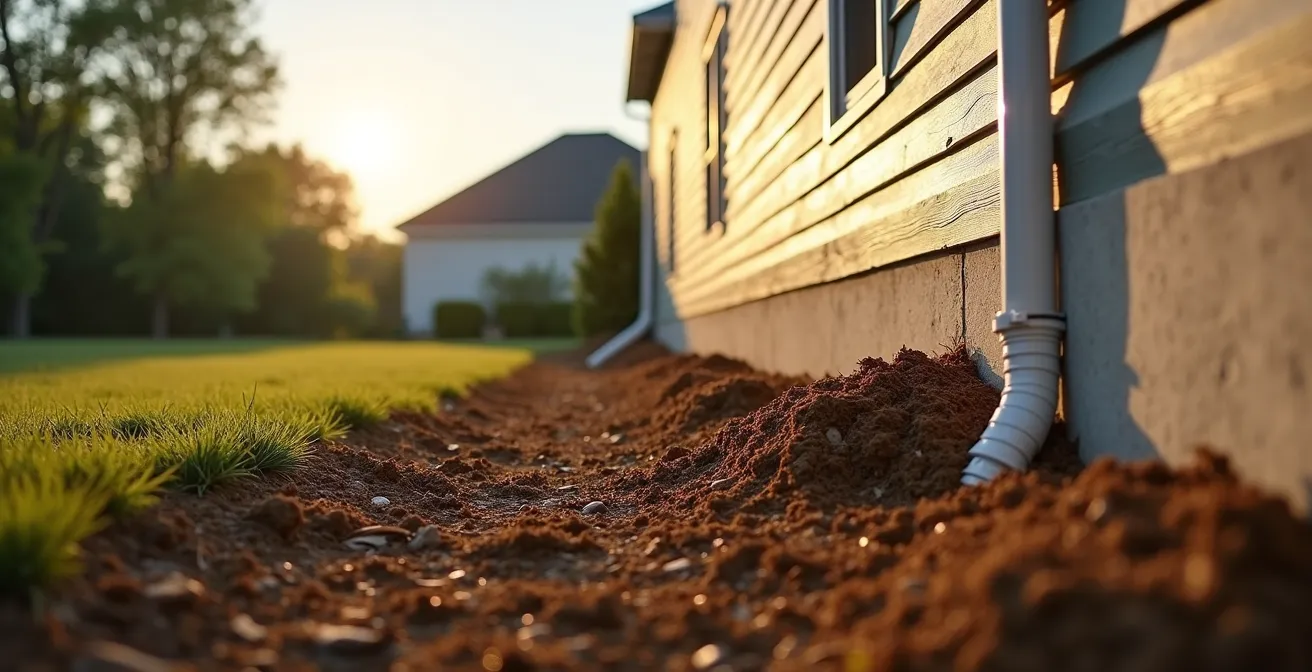
This image perfectly illustrates the problem: negative grading and poorly placed downspouts create a direct path for water to assault the foundation. As noted in professional inspection guides, this moisture infiltration is destructive. Dalinghaus Construction highlights a critical effect: when water reaches the steel rebar inside the concrete, the resulting rust can exert up to 9,000 PSI of expansive pressure, literally breaking the concrete apart from the inside. Their protocol involves checking for silt in sump pits, which indicates a persistent drainage problem that the pump is struggling to keep up with.
Don’t just look for active leaks. Look for the system’s design flaws. Is the house at the bottom of a hill? Are the window wells filled with leaves and debris? These are not cosmetic issues; they are indicators of a future structural problem just waiting for a heavy rainstorm to manifest.
General Inspector vs Structural Engineer: Who Should You Hire for an Old House?
After your walkthrough, you hire a general home inspector. Their report comes back with a note: “Hairline cracks observed in basement. Recommend monitoring.” For many buyers, this is a green light. For a skeptical builder, it’s an immediate, non-negotiable trigger to call in a specialist: a licensed structural engineer. Understanding the difference between these two roles is critical to protecting your investment, especially with an older home.
A general home inspector is a jack-of-all-trades. They follow a broad checklist covering hundreds of items, from appliances to plumbing to the roof. Their job is to identify *potential* issues. However, they are not typically qualified to render a definitive opinion on structural integrity. Their report is advisory, a list of observations, not a certified diagnosis. As one professional guide from Batten To Beam Inspections puts it:
Home inspectors can identify many foundation issues, they are not typically structural engineers or foundation specialists. If significant concerns are identified, it may be necessary to consult with a structural engineer.
– Professional Home Inspector, Batten To Beam Inspections Foundation Guide
A structural engineer, on the other hand, is a specialist with a legally binding professional capacity. When they analyze a foundation, their output is not a checklist but a certified structural analysis. This document holds legal weight. It provides not just an opinion but an engineered solution with certified cost estimates. This distinction is everything in a negotiation.
This table clarifies the critical differences in their roles and deliverables:
| Aspect | Home Inspector | Structural Engineer |
|---|---|---|
| Report Type | Broad checklist of potential issues | Stamped, certified structural analysis |
| Legal Weight | Advisory only | Legally binding professional opinion |
| Cost Estimates | General ranges | Certified repair cost estimates |
| Repair Plans | Recommendations only | Detailed engineered solutions |
| When to Call | Initial assessment | Cracks >1/4″, horizontal cracks, floors sloped >1″ over 15ft |
For an old house with any signs of settlement, moisture intrusion, or visible cracks, the $500-$1,000 for an engineer’s report is not a cost; it’s the cheapest insurance you can buy against a $20,000 mistake.
The “Lipstick on a Pig” Signs That Reveal a Poor Quality Flip
House flippers are masters of illusion. Their goal is to create a “wow” factor that distracts you from underlying problems. They know that new light fixtures and fresh paint are cheap, high-impact upgrades that create an impression of quality. Your job is to ignore the “wow” and look for the tell-tale signs of rushed, surface-level work that often conceals deeper issues. This is where you need a builder’s cynical eye for detail.
Fresh paint, especially in a basement or garage, is the number one red flag. A single freshly painted wall is almost always hiding something—usually a crack or signs of water intrusion. But even a full paint job can be revealing. Don’t just look at the wall; look *along* it. Hold your phone’s flashlight parallel to the surface. This technique, called “raking light,” will expose every bump, patch, and texture inconsistency, revealing where drywall repairs were hastily made. A quality job is smooth; a cover-up is a landscape of imperfections.

Next, look at the points where new meets old. The macro shot above shows a classic example: a brand-new, shiny fixture mounted to an old, stained, and clearly deteriorated surface. This screams “cosmetic fix.” The flipper spent $50 on the fixture but ignored the underlying water damage or old wiring it’s attached to. Look for this pattern everywhere: pristine switch plates over paint-covered outlets, new cabinet hardware on old, warped cabinet boxes, and beautiful new faucets on a worn-out sink.
The flooring is another major area of deception. Cheap floating LVP (Luxury Vinyl Plank) is a flipper’s best friend because it can be laid directly over almost any surface, including uneven, cracked, or settled subfloors. Check the baseboards for inconsistent gaps. A large, uneven gap between the bottom of the baseboard and the new floor is a dead giveaway that the floor underneath is not level.
Action Plan: Detecting a Poor-Quality Flip
- Use a phone flashlight held parallel to freshly painted walls to reveal texture differences and patches.
- Check for brand new fixtures attached to old, stained ceiling boxes or worn sinks.
- Look for pristine switch plates covering yellowed or paint-covered receptacles.
- Inspect baseboards for inconsistent gaps indicating floating LVP flooring laid over uneven subfloors.
- Search for single freshly painted walls in otherwise old-looking basements or garages, often hiding cracks or moisture.
How to Negotiate $5,000 Off the Price Using the Inspection Report?
The inspection report—especially one from a structural engineer—is not just an informational document; it is your single most powerful negotiation tool. Finding a defect isn’t a dead end; it’s the beginning of a business transaction. The key to successful negotiation is to frame the issue not as your problem, but as an inherent, documented flaw in the property that the seller now legally owns.
The leverage comes from two places: cost escalation and legal disclosure. First, you must anchor the negotiation in hard numbers. It’s not about a “crack in the wall.” It’s about the documented cost of remediation. A study shows a hairline crack caught early costs $200-$800 to seal, but if it indicates a systemic issue requiring underpinning, that cost can easily escalate to $10,000-$15,000. Your negotiation should be based on the engineer’s certified estimate for the *correct* long-term repair, not a cheap, temporary patch.
Second, and most importantly, is the power of disclosure. As documented in negotiation case studies by CalPro Inspection Group, once a seller receives a certified report from a structural engineer detailing a defect, they are legally obligated in most jurisdictions to disclose that report to *all* future potential buyers if your deal falls through. This changes the entire dynamic. The problem is no longer your subjective concern; it is a material fact attached to the property. The seller can’t simply hope the next buyer won’t notice. They are now highly motivated to resolve the issue with you, the buyer who is already at the table.
When you approach the seller, you don’t make emotional pleas. You present a logical, evidence-based case: “Per the attached certified engineer’s report, the required repair for the foundation settlement is estimated at $12,000. We are prepared to proceed with the purchase if you agree to a price reduction or credit of $X to cover these unforeseen costs.” You have transformed a “problem” into a clear, undeniable line item on a balance sheet.
How to Audit Your Supply Chain Partners for Cybersecurity Vulnerabilities?
In the modern home buying process, structural integrity is not the only hidden risk. A significant, and often overlooked, vulnerability lies within the transaction itself. Your “supply chain” of partners—your real estate agent, mortgage lender, title company, and inspector—all handle your most sensitive personal and financial data. A single weak link in this chain can expose you to wire fraud, identity theft, and significant financial loss. A builder’s skeptical mindset must extend beyond the physical property to the digital process.
The most prevalent threat is real estate wire fraud. Scammers compromise the email account of someone involved in the transaction (often the agent or title officer) and send fraudulent wiring instructions at the last minute. The unsuspecting buyer wires their life savings to the scammer’s account, and the money is gone in an instant. This is not a rare occurrence; it’s a multi-million dollar criminal enterprise targeting homebuyers.
Your audit of this process must be rigorous. You need to proactively question each partner’s security protocols. Do they use encrypted email or a secure portal for sharing documents like bank statements and social security numbers? If they are still using standard, unencrypted email, that is a major red flag. Furthermore, you must establish a clear protocol for verifying payment instructions. The cardinal rule is to never trust wire instructions sent via email. Always verify the account numbers verbally, using a phone number for the title company that you have sourced independently (from their official website, not from an email signature).
The audit checklist for your transaction partners should include these non-negotiable points:
- Ask all partners (agent, lender, title company) if they use secure, encrypted portals for document transmission.
- Verbally confirm all wire transfer instructions using an independently verified phone number.
- Immediately treat any last-minute email changes to payment instructions as a primary indicator of fraud.
- Inquire about the title company’s specific insurance coverage for wire fraud.
- Upon taking possession, factory reset all smart home devices and immediately change all default passwords.
Treat the security of your transaction with the same diligence you apply to the foundation. A hidden digital crack can be just as costly as a physical one.
The Permit Mistake That Can Stall Your Project for 3 Months
One of the most insidious problems in a flipped house is unpermitted work. A beautifully finished basement or a new deck might be a major selling point, but if it was built without the required municipal permits and inspections, it’s not an asset—it’s a massive liability. This is a classic flipper shortcut, saving a few thousand dollars on permits and process, while creating a potential legal and financial time bomb for the next owner.
The risks are threefold. First, safety: permits ensure that work (especially electrical, plumbing, and structural) is done to code. Unpermitted work has not been inspected and could be a fire or safety hazard. Second, legal: the city could discover the unpermitted work years later and force you to either bring it up to code at great expense or tear it out entirely. Third, financial: this is where it hits hardest. As one industry report highlights, this can create a major crisis during the sale itself.
A documented case study showed a home with an unpermitted finished basement that required foundation repairs costing between $20,000 and $23,000. The buyer’s lender refused to include the unpermitted square footage in their appraisal valuation, creating a massive gap. The loan couldn’t cover repairs for a space that, on paper, didn’t legally exist. The entire project stalled for months while the sellers scrambled to retroactively permit the work, a costly and uncertain process.
Furthermore, your own insurance may not protect you. As the Angi Foundation Repair Cost Guide points out, there’s a critical exclusion in many policies:
Standard title insurance policies often have an exception for issues arising from unpermitted work. This means if the city later forces you to tear out an unpermitted addition, you have no recourse.
– Foundation Repair Industry Report, Angi Foundation Repair Cost Guide 2025
You must verify the permit history for any significant renovation. Go to the city’s building department website or office and pull the permit records for the address. If you see a new bathroom, a finished basement, or a new deck, but no corresponding permits, you haven’t found an upgrade; you’ve found a red flag.
Key takeaways
- A flipper’s high-ROI upgrades (paint, flooring) are often designed to hide a home’s most expensive problems (foundation, drainage).
- The authority of a structural engineer’s report is your ultimate negotiation tool, turning subjective concerns into legally binding facts.
- Hidden risks are not just physical; unpermitted work and cybersecurity flaws in the transaction can be just as financially devastating as a cracked foundation.
Which Property Upgrades Yield the Highest ROI for Flips Under 6 Months?
To truly understand how to protect yourself, you must understand the flipper’s playbook. A successful flip is about maximizing the perceived value while minimizing cost and time. This means focusing on cosmetic upgrades with a high return on investment (ROI). Your task is to recognize these upgrades not as features, but as potential diversions from the issues that have a negative ROI—the major structural repairs.
The flipper’s budget is allocated to what buyers see and touch: kitchen cabinet paint, new light fixtures, and cheap but attractive flooring. They are not allocating funds for what they hope you’ll never discover. The cost of foundation lifting and leveling costs can be $10,000-$23,000 or more. For a flipper on a tight margin and a six-month timeline, that’s a project-killing expense. It is always cheaper to hide the problem than to fix it correctly.
This creates a fundamental conflict of interest between the seller and the buyer. The seller invests in the surface, while the buyer inherits the structure. The following table, based on data from industry cost guides, breaks down the flipper’s favorite high-ROI upgrades and the serious, high-cost problems they are so effective at concealing.
| High-ROI Flipper Upgrade | What It Often Hides | Repair Cost if Discovered |
|---|---|---|
| Kitchen Cabinet Painting | Mold/water damage behind cabinets | $2,000-$7,000 |
| Cheap LVP Flooring | Uneven subfloors from foundation settling | $4,500-$20,000 |
| New Light Fixtures | Dangerous old wiring | $1,500-$3,000 |
| Fresh Mulch & Paint | Foundation cracks & drainage issues | $10,000-$30,000 |
This table is the essence of the builder’s mindset. It teaches you to look at a new kitchen not as a feature, but as a reason to look harder for hidden mold. It reframes fresh paint not as a benefit, but as a potential sign of a multi-thousand-dollar foundation issue. By knowing the flipper’s playbook, you can read between the lines of a renovation and focus your inspection on the areas of greatest financial risk.
By adopting this skeptical, system-based approach, you move from being a passive buyer to an active investigator. Your walkthrough becomes a forensic analysis, and the inspection report becomes your leverage. This is how you avoid the money pit and secure a sound investment.