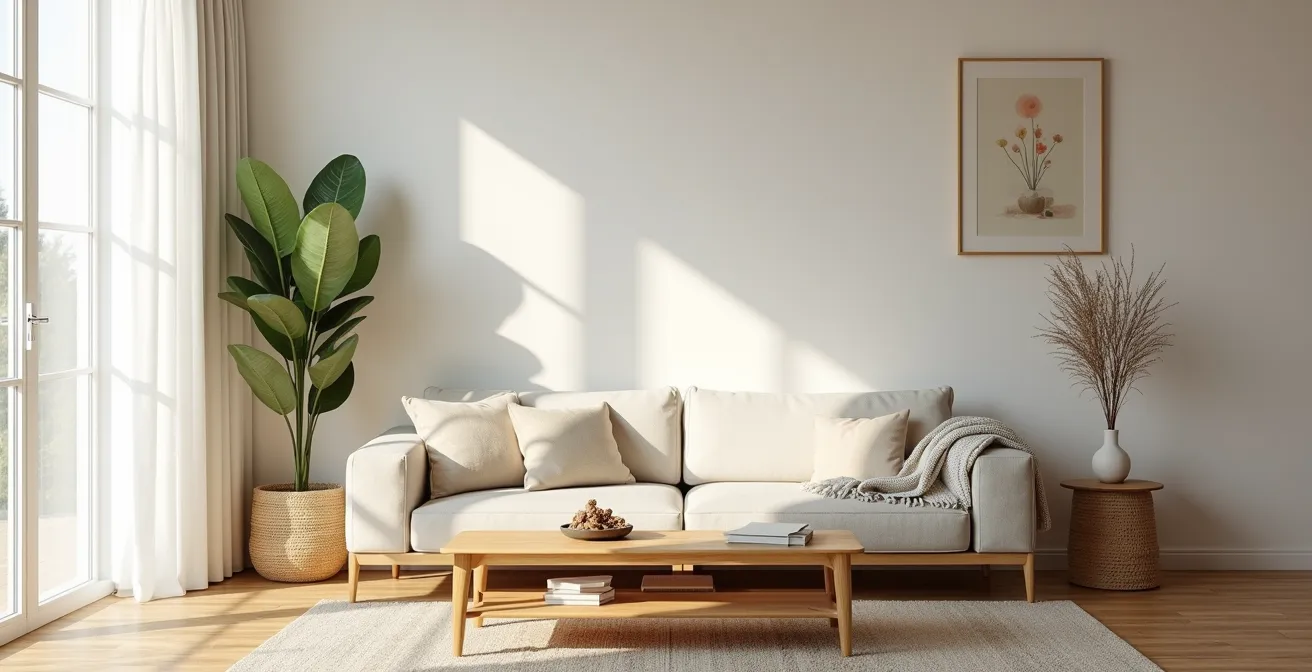
Transitioning to a minimalist home isn’t about what you remove, but about what you intentionally choose to keep to create a life-giving space.
- Visual clutter is scientifically proven to increase stress and reduce focus, directly impacting your mental well-being.
- “Warm minimalism”—using texture, plants, and color—creates a functional family sanctuary, not a sterile showroom.
Recommendation: Start by changing your mindset from “deprivation” to “curation” to build a home that actively supports your life.
The desire for a simpler, less cluttered life often clashes with a deep-seated fear: that minimalism equals a cold, empty, and joyless existence. You look around at the stuff that fills your home—the souvenirs, the books, the kids’ drawings—and while you feel the weight of the clutter, you also see a life lived. The common advice to just “get rid of everything you haven’t used in a year” feels brutal and dismissive of the stories your objects tell. You’re overwhelmed, but the thought of a sterile, white-walled box is even less appealing.
This is the paradox that traps so many of us. We crave the mental clarity and ease of maintenance that minimalism promises, but we resist the perceived sacrifice. We see it as a process of subtraction and loss. But what if this entire premise is wrong? What if the true path to a minimalist home isn’t about deprivation at all, but about intentional inclusion? The goal isn’t to empty your house, but to transform it into a cognitive sanctuary, a space curated with only the things that support, serve, and bring you joy.
This guide offers a different path. It’s a philosophical yet actionable strategy for reducing your possessions without reducing your sense of self. We will explore the science behind why clutter drains you, how to reclaim key spaces, and how to build a warm, inviting minimalist home that works for a real family. This is about creating a life-giving environment, not a lifeless one.
To navigate this journey effectively, this article will guide you through the foundational principles and practical applications of a more humane approach to minimalism. Explore the sections below to build your strategy step-by-step.
Summary: A Guide to Creating a Minimalist Home Full of Warmth and Purpose
- Why Reducing Visual Clutter Immediately Lowers Your Mental Fatigue?
- How to Declutter Your Kitchen Counters and Keep Them Clear Forever?
- Warm Minimalism vs Sterile Design: Which Fits a Family Lifestyle?
- The Storage Bin Trap That Actually Increases Your Household Clutter
- When to Apply the “One In, One Out” Rule to Maintain Your Wardrobe?
- Why Incorporating Plants in Your Office Boosts Focus by 15%?
- The Calorie Tracking Trap That Leads to Binge Eating
- Why Specific Color Palettes Increase Productivity in Home Offices by 20%?
Why Reducing Visual Clutter Immediately Lowers Your Mental Fatigue?
The feeling of being drained by a messy room isn’t just in your head; it’s a measurable neurological response. Your brain has a finite amount of attention and processing power. When your environment is filled with “visual noise”—piles of mail, excess decor, items without a home—each object sends a signal to your brain, competing for attention. This creates a state of low-grade, continuous cognitive overload, making it harder to focus on what truly matters. As the Nuvance Health Research Team notes, this is a significant drain on our mental resources.
Studies have described clutter as a form of visual distraction that increases cognitive overload and even reduces working memory capacity. When your space is overloaded with extraneous stuff, it’s harder for your brain to hold on to the important pieces of information you need right now.
– Nuvance Health Research Team, Nuvance Health – How Clutter Affects Your Brain Health
This phenomenon, known as “visual crowding,” directly impacts how your brain processes information. Research from Yale University found that clutter in your peripheral vision can alter the flow of information between neurons, making it difficult to identify specific objects and thoughts. This isn’t just about untidiness; it’s about your brain working overtime just to establish a baseline. Studies even show that visual clutter can reduce productivity by up to 40% because your mental energy is being constantly diverted to process a chaotic environment.
By intentionally reducing the number of objects in your field of vision, you are not just cleaning up; you are freeing up precious cognitive resources. A clear surface, an organized shelf, or an empty corner gives your brain a place to rest. This reduction in sensory input immediately lowers cortisol levels (the stress hormone) and allows your mind to shift from a state of passive defense to one of active, clear-headed thinking. It’s the first and most profound benefit of a minimalist approach: giving your mind the space it needs to breathe.
How to Declutter Your Kitchen Counters and Keep Them Clear Forever?
The kitchen counter is often the epicenter of household clutter. It’s a magnetic surface for mail, keys, half-finished projects, and appliances used once a year. Reclaiming this space is a powerful first step in your minimalist journey because its impact is felt daily. The secret to keeping it clear forever isn’t about constant cleaning, but about creating an intuitive system where everything has a logical home.
Instead of seeing the counter as a single storage surface, think of your kitchen in terms of “zones” based on tasks: a prep zone, a cooking zone, a cleaning zone, and a beverage zone. Keep only the absolute essentials for each zone on the counter. Cooking utensils go in a crock near the stove, not scattered across the counter. Knives belong in a block or on a magnetic strip right by your main cutting board. This simple re-organization streamlines your movements and makes it obvious when something is out of place. It transforms the counter from a dumping ground into a functional workspace.
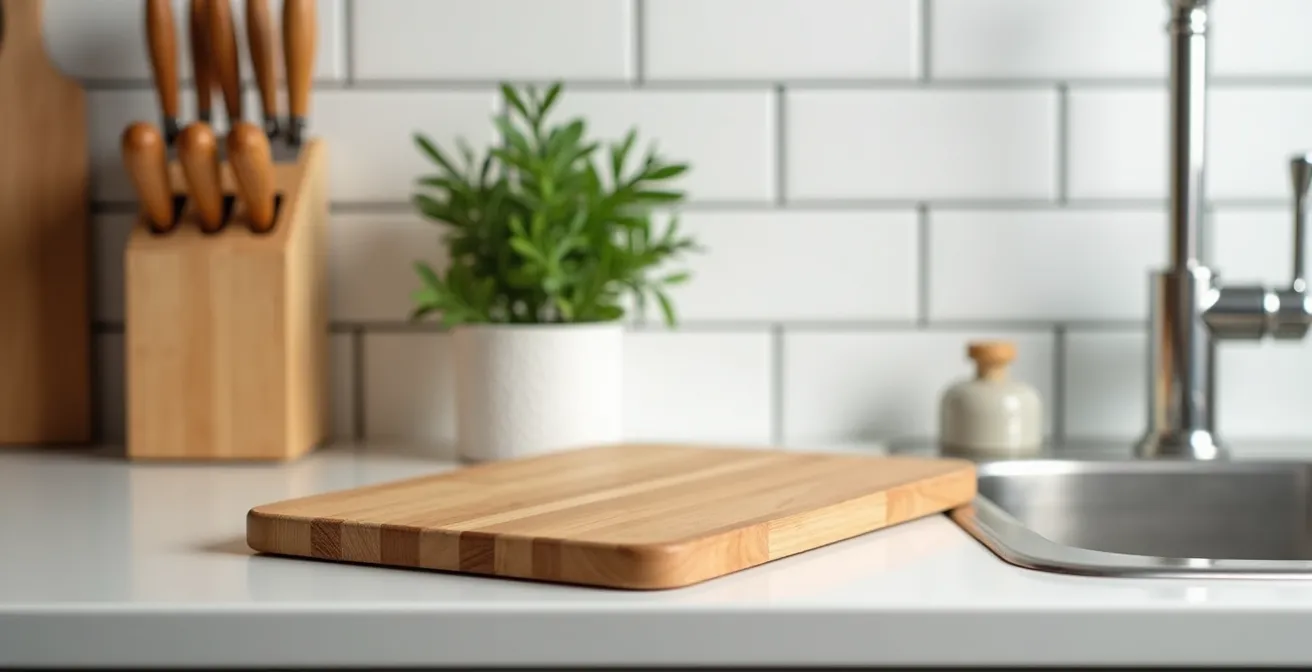
For all other items, the goal is to get them off the counter. Create an “appliance garage” in a nearby cabinet for the blender, toaster, and stand mixer. These are items you need, but not every second of the day. Freeing your counter from their visual weight makes a huge difference. Here is a simple system to implement:
- Assign Zones: Designate specific areas of your counter and adjacent drawers for food prep, cooking, and cleaning. Store items where you use them.
- Daily Essentials Only: Allow only 1-3 items you use every single day to live on the counter (e.g., your coffee maker, a fruit bowl). Everything else needs a home behind a cabinet door.
- Create Vertical Storage: Use wall-mounted shelves for spices or a magnetic knife strip to free up counter real estate.
- Implement a “Closing Shift”: Just like a restaurant, take 5 minutes every evening to clear the counters, wipe them down, and “close” the kitchen. This resets the space for a calm morning.
Warm Minimalism vs Sterile Design: Which Fits a Family Lifestyle?
One of the biggest misconceptions about minimalism is that it must be cold, stark, and impersonal—a look more suited to an art gallery than a family home. This is the image of “sterile design,” characterized by pure whites, hard lines, and an absence of personal touches. For a family, this is not only impractical but undesirable. The alternative is Warm Minimalism, a philosophy that combines the clarity of minimalist principles with the comfort and personality of a lived-in home.
Warm minimalism isn’t about having nothing; it’s about being highly selective. It embraces clean lines and uncluttered surfaces but layers them with natural textures, a soft color palette, and curated personal items. Think of a cozy wool blanket draped over a simple sofa, a few healthy plants catching the sunlight, or a single, beautifully framed piece of your child’s art on an otherwise clear wall. It’s about creating a space that feels both peaceful and personal, functional and full of soul.
This approach is perfectly suited for family life because it’s flexible and forgiving. It acknowledges that life with children involves “stuff,” but it provides a framework for managing it. This means smart, accessible storage for toys, designated zones for creative messes, and a focus on durable, natural materials that feel good to the touch. The key difference lies in the intention, as this comparison shows.
| Aspect | Warm Minimalism | Sterile Design |
|---|---|---|
| Color Palette | Natural tones: beige, sage, pale apricot, sand | Pure white, gray, black only |
| Textures | Wood, linen, wool, varied tactile surfaces | Smooth, uniform surfaces |
| Personal Items | Curated meaningful art/photos displayed | No personal items visible |
| Natural Elements | Plants, natural light, organic materials | Minimal natural elements |
| Family Functionality | Smart accessible toy storage, zoned spaces | Everything hidden away |
By choosing warm minimalism, you are not sacrificing your family’s comfort for an aesthetic. Instead, you are creating a resilient, beautiful, and functional backdrop for your life that reduces stress without erasing personality. This is a crucial distinction from the often-intimidating images of sterile minimalism found in magazines, as confirmed by insights from design experts who champion livable spaces.
The Storage Bin Trap That Actually Increases Your Household Clutter
When faced with clutter, our first instinct is often to go out and buy more storage solutions: bins, boxes, baskets, and elaborate drawer dividers. This feels productive, but it’s a dangerous trap. Organizing clutter is not the same as eliminating it. More often than not, storage bins become “clutter coffins”—out-of-sight dumping grounds for things we lack the time, energy, or emotional capacity to make a decision about. This simply hides the problem, it doesn’t solve it.
The truth is, these bins often enable us to hold onto more stuff than we need, filling our closets, basements, and garages with items that don’t serve our current lives. This is why many people with impeccably organized closets full of matching bins still feel overwhelmed. As the experts at Abundant Life With Less wisely state, the solution lies in ownership, not organization.
We know that organizing our stuff doesn’t necessarily ever lead to organization. The secret to getting organized is to own less stuff all together. Your kitchen doesn’t need thousands of items, it just needs the right items for you.
– Abundant Life With Less, 3 Principles of a Minimalist Kitchen
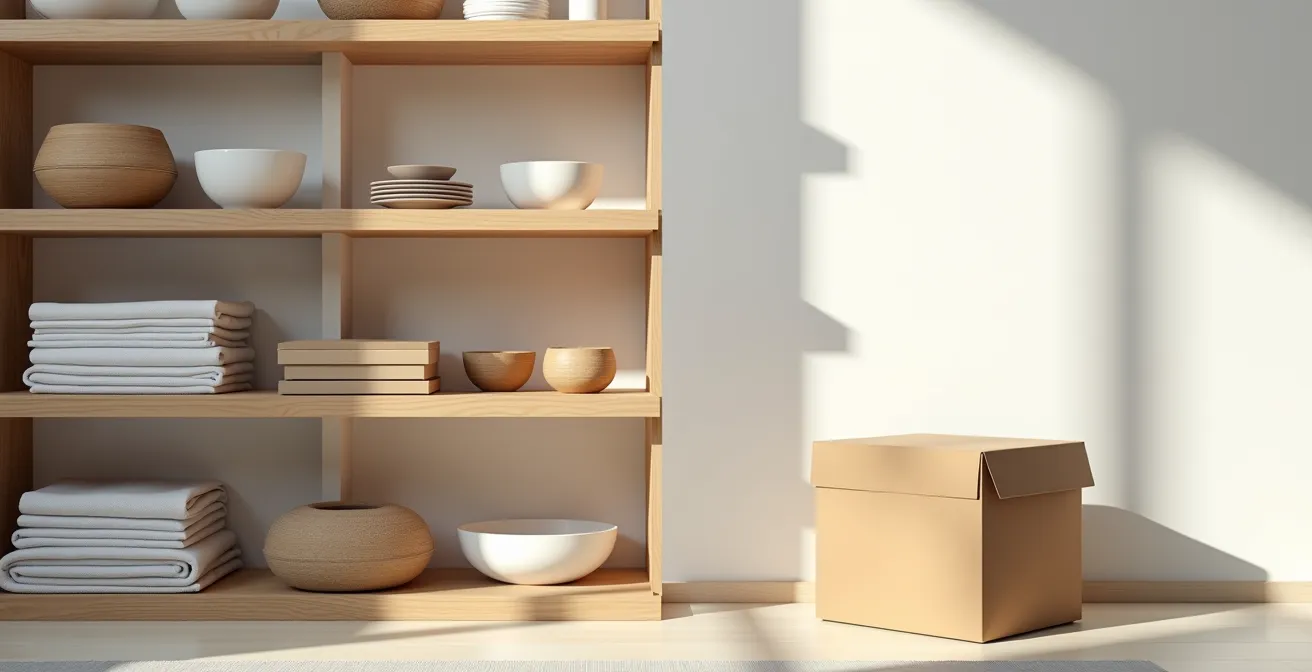
A more powerful approach is the “Quarantine Box” method. Instead of immediately buying a decorative bin for uncertain items, place them in a simple cardboard box. Seal it, label it with the date, and store it out of the way. Set a reminder on your calendar for six months. If you haven’t needed to open that box in six months, you have your answer: you don’t need its contents. Donate or discard the entire box, unopened. This method forces a real decision instead of procrastination, helping you break the cycle of simply managing clutter.
Your 5-Step Clutter Quarantine Audit
- Points of Contact: Identify all “clutter hotspots” where items accumulate (e.g., entryway table, kitchen counter, nightstand). Choose one to start.
- Collect: Inventory the contents of one storage bin or hotspot. List what’s *actually* in there (e.g., old cables, single socks, expired coupons).
- Coherence: Confront each item with your core values. Ask, “Does this serve my current life, or a past/fantasy self?”
- Mémorabilité/Emotion: Separate items into three piles: ‘Keep with Joy,’ ‘Quarantine,’ and ‘Let Go.’ Notice the feeling each pile gives you—relief or anxiety?
- Plan d’Intégration: For the ‘Keep’ pile, find a permanent, accessible home. For ‘Quarantine,’ seal the box, date it, and set a 6-month reminder to discard if unopened.
When to Apply the “One In, One Out” Rule to Maintain Your Wardrobe?
After the initial, satisfying work of decluttering, the real challenge begins: maintenance. How do you prevent the slow, insidious return of clutter? For areas with a high turnover of items, like your wardrobe, the “One In, One Out” rule is a simple yet profoundly effective strategy. The rule is exactly as it sounds: for every new item you bring into your home, a similar item must leave. Buy a new pair of jeans, and an old pair must be donated or discarded. This isn’t a punishment; it’s a mechanism for maintaining equilibrium.
This rule is best applied *after* you have curated your wardrobe down to a collection of items you truly love and wear. Applying it to a closet that’s already overflowing is overwhelming. But once you have a functional baseline, it becomes a powerful tool for mindful consumption. Before you buy something new, you are forced to ask: “What will I let go of to make space for this? Is this new item so much better than what I already have that it’s worth the swap?” This simple question can stop dozens of impulse purchases in their tracks.
It shifts your mindset from passive accumulation to active curation. You are no longer just a consumer; you are the dedicated curator of your own closet. This principle helps you invest in quality over quantity, as you know each new piece has to earn its place.
Case Study: The Power of a Curated Wardrobe
Minimalism advocate Joshua Becker famously described his journey from a closet overflowing with cheap, fast-fashion items to a curated collection of basics. By paring down his wardrobe, he realized he didn’t need twenty pairs of pants or a dozen watches. This shift allowed him to apply the “one in, one out” principle effectively, but also to invest more in the items he truly valued. As he noted, by not needing six different watches, he could afford to buy one really nice one that he loved. This illustrates how the rule isn’t about restriction, but about upgrading your life by focusing on quality and intention.
The “One In, One Out” rule is most effective for categories like clothing, shoes, books, and mugs—areas where we tend to accumulate duplicates. It transforms the act of shopping from a fleeting thrill into a conscious, deliberate choice, ensuring your home remains the sanctuary you worked so hard to create.
Why Incorporating Plants in Your Office Boosts Focus by 15%?
True minimalism isn’t about stark emptiness; it’s about intentionally adding elements that enhance your life. After removing the visual clutter that drains your energy, the next step is to introduce elements that actively replenish it. In a home office, nothing does this better than plants. The positive effect of nature on our brains is a well-documented phenomenon known as biophilia, and the impact on focus is significant.
Studies have shown that introducing natural elements into a workspace can have a powerful restorative effect on our minds. According to a study highlighted by Nuvance Health, a clutter-free environment enhances cognitive control, and adding plants can go a step further. In fact, research indicates that the presence of plants and natural elements can boost focus by up to 15%. This happens because nature provides a unique kind of stimulation for the brain.
Unlike the “hard fascination” of a phone notification or an incoming email, which aggressively demands your directed attention, plants offer what is called “soft fascination.” Looking at a leaf, a stem, or the texture of the soil allows your directed-attention abilities to rest and recover. This mental pause is what replenishes your capacity to tackle demanding cognitive tasks, like writing a report or analyzing data. A plant is a silent partner in your work, helping you restore focus without creating a distraction.
Furthermore, the simple act of caring for a plant—watering it, removing a dead leaf—serves as a micro-mindfulness exercise. It pulls you away from the screen, grounds you in the physical world, and can lower stress hormones. For a minimal investment, a few well-placed plants can transform a sterile office into a living, breathing space that actively supports your concentration and creative problem-solving.
The Calorie Tracking Trap That Leads to Binge Eating
Interestingly, the psychological traps we fall into with dieting have a powerful parallel in our journey with minimalism. Consider the rigid world of calorie tracking. For some, it’s a useful tool. For many others, it becomes an obsession with numbers that disconnects them from their body’s natural signals. This obsession can lead to a cycle of restriction and binging, where the focus on a numerical goal completely overshadows the pursuit of genuine health. The exact same trap exists in decluttering.
This is the “decluttering by numbers” trap. You might hear about challenges like “get rid of 500 items” or follow rigid rules that dictate you must own fewer than 100 things. Like calorie counting, this can be motivating at first, but it quickly becomes a source of anxiety. It turns a personal journey of curation into a stressful, impersonal game. You start focusing on hitting a number rather than listening to your intuition about what an object means to you. This can lead to “decluttering regret,” where you discard something important just to meet a quota, followed by “re-cluttering binges” to fill the void.
The antidote, just as in mindful eating, is to move from rigid tracking to intuitive awareness. Instead of counting items, focus on how your space *feels*. Here are some alternatives to rigid decluttering rules:
- Use an “Item Usefulness Journal”: Instead of a number, make a note of the last time you used an item. The pattern will tell you more than a count.
- Practice “Object Reflection Notes”: For an item you’re unsure about, jot down the feeling it gives you (e.g., “guilt,” “joy,” “nostalgia”) rather than its numerical value.
- Focus on Space Awareness: Pay attention to how much visual and physical space an object occupies. Is the value it provides worth the space it takes up?
- Track Clutter Patterns: Notice *where* clutter accumulates. This reveals patterns in your habits, which is more useful information than the total number of items.
By shifting from a quantitative to a qualitative approach, you build a sustainable, kinder relationship with your belongings. You learn to trust your own judgment about what adds value to your life, creating a home that is right for you, not one that adheres to an arbitrary number.
Key takeaways
- Minimalism is not about deprivation, but the intentional curation of a home that supports your well-being.
- Visual clutter is a scientific reality that increases stress and cognitive load; clearing it directly boosts mental clarity.
- Warm minimalism, using textures, plants, and meaningful items, is the key to creating a home that is both simple and soulful.
Why Specific Color Palettes Increase Productivity in Home Offices by 20%?
Once your space is decluttered, you have a blank canvas. This is an opportunity to use color not just as decoration, but as a strategic tool to enhance the function of a room, particularly a home office. Color psychology is a powerful force; the right palette can calm your mind for deep work, while the wrong one can create subtle agitation and distraction. The goal is to create an environment that supports your specific type of work.
Designers often use the 60-30-10 rule as a framework for creating a balanced and effective color scheme. In this model, 60% of your space (the walls) should be a dominant, neutral color that serves as a non-distracting foundation. 30% of the space (furniture, rugs) should be a secondary color that adds personality. Finally, 10% (accents like pillows, art, or a desk lamp) should be a bold accent color that provides energy and visual interest. This structured approach prevents a space from feeling either boring or chaotic.
The specific colors you choose within this framework should be tailored to the primary task you perform in that room. Different colors evoke different psychological responses, and you can leverage this to improve your focus and creativity. For example, a writer who needs sustained concentration would benefit from a different palette than a graphic designer who needs to brainstorm creative ideas.
| Work Type | Recommended Palette | Saturation Level | Expected Effect |
|---|---|---|---|
| Deep Focus Writing | Muted greens and greys | Low saturation | Calming, sustained concentration |
| Creative Design | Neutral base + orange/yellow accents | High saturation accents only | Stimulating without overwhelming |
| Video Calls | Soft blues and beiges | Medium saturation | Professional, calming presence |
| Analytical Work | White and light grey | Minimal saturation | Mental clarity, reduced distraction |
By thoughtfully applying a color strategy, you complete the final step of the minimalist transition. You move beyond simply removing what you don’t need and begin intentionally crafting a space that actively helps you live and work better. It’s the ultimate expression of curation: a home that is not only clean and organized, but also finely tuned to support your mind.
Now that you have a complete framework—from decluttering your mind to curating your physical space—the journey is no longer about what you must give up. It is about the peace, focus, and joy you stand to gain. Your home can be your greatest ally in a busy world, a sanctuary you have intentionally and lovingly built. Begin today by applying these strategies, not as rigid rules, but as supportive guides to creating a home that truly serves you.