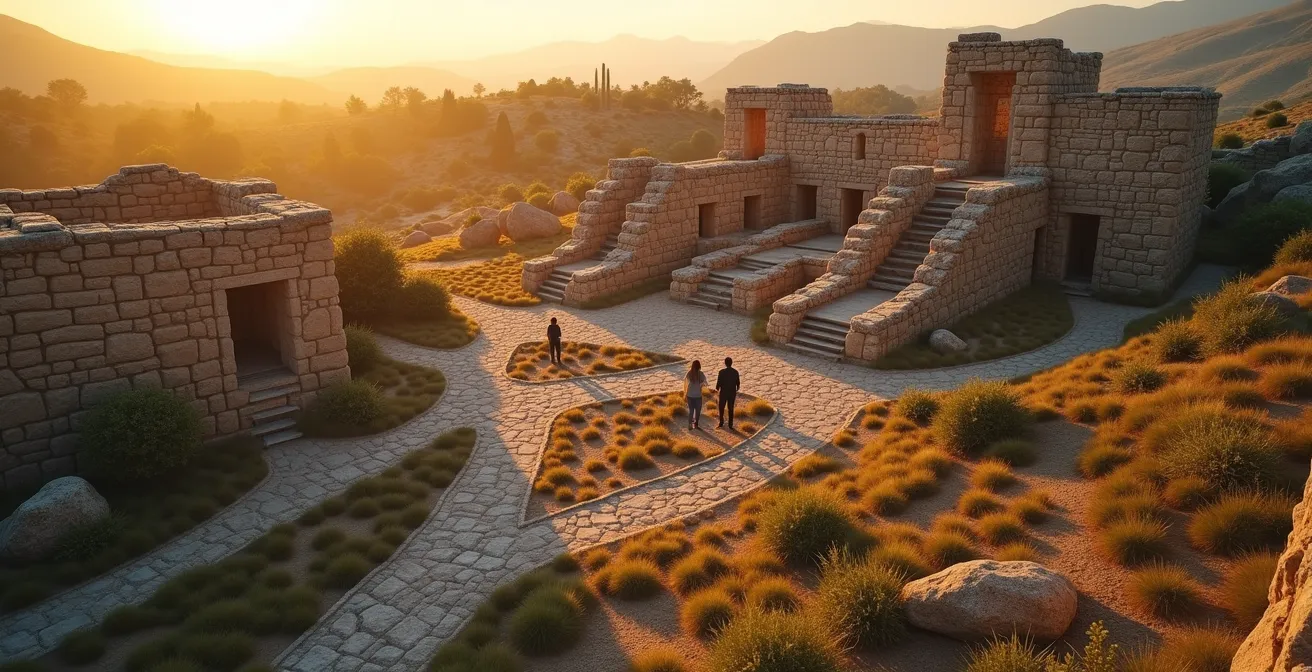
Visiting UNESCO sites without causing harm requires shifting from a passive tourist to an active, intentional steward of heritage.
- Intellectual preparation before your visit builds the empathy necessary for respectful interaction with the site.
- Your choices on the ground—from the guide you hire to the time you visit—directly impact the site’s physical and cultural integrity.
Recommendation: Your visit becomes a positive contribution when your behavior, spending, and awareness directly support local conservation efforts and the community that safeguards the site’s legacy.
The desire to stand before the wonders of human history is a powerful one. We see the Colosseum, Machu Picchu, or the temples of Angkor Wat and feel an irresistible pull to connect with our shared past. Yet, this collective admiration carries a profound risk. The very presence that we believe honors these places can inadvertently accelerate their decline. The term “overtourism” is now common, evoking images of crowds so dense they obscure the very monuments people came to see, eroding ancient stones and overwhelming local communities.
The standard advice often feels like a simple checklist: visit in the off-season, stay on the path, don’t use a flash. While these rules are important, they address the symptoms, not the root cause. They frame the traveler as a potential problem to be managed, a force to be contained. This approach misses the fundamental opportunity for tourism to be a force for good, a vital source of funding and global advocacy for preservation.
But what if the true path to responsible heritage tourism isn’t about following a longer list of rules, but about cultivating a different mindset altogether? The key lies in shifting from a passive consumer of scenery to an active participant in preservation. This is the practice of intentional stewardship, where your visit is guided by a deep intellectual and emotional engagement with a site’s history, fragility, and the living community that surrounds it. It transforms your journey from a simple sightseeing trip into a meaningful act of cultural support.
This guide is designed to help you make that shift. We will explore how to prepare for your visit, how to choose the right guides and tools for deep understanding, and how your on-site behavior can either protect or harm these irreplaceable treasures. By the end, you will have a framework for visiting the world’s most incredible places in a way that ensures they survive for generations to come.
Summary: How to Visit UNESCO Sites Without Contributing to Overtourism Damage?
- Why Reading About a Site’s History Beforehand Doubles Your Appreciation?
- How to Find Licensed Guides Who Are Actually Historians?
- Audio Guide vs Human Guide: Which Is Better for Complex Archaeological Sites?
- The disrespectful Selfie Behavior That Can Get You Banned from Sacred Temples
- When to Visit Popular Ruins to Avoid the Cruise Ship Crowds?
- When to Visit Nesting Sites to Observe Without Disrupting the Animals?
- The “Aging” Techniques Scammers Use to Fake Antiques
- Which Eco-Lodges Actually Contribute More than 50% to Local Conservation?
Why Reading About a Site’s History Beforehand Doubles Your Appreciation?
Arriving at a World Heritage site without prior knowledge is like walking into the final act of a play; you see the spectacle, but you miss the entire story. The foundation of intentional stewardship begins long before you book a flight. It starts with an investment in understanding. This pre-visit research is not academic homework; it’s an act of intellectual empathy that transforms passive viewing into active, meaningful observation. When you understand the political intrigue behind a palace’s construction or the spiritual beliefs that shaped a temple’s layout, the stones cease to be just old rocks. They become witnesses to human drama, innovation, and struggle.
This preparation fundamentally changes what you see. A simple carving is no longer just a decoration but a symbol you’ve read about. An empty field becomes the site of a pivotal battle you’ve studied. This context allows you to appreciate the subtle details that 99% of visitors walk right past. More importantly, it fosters a profound sense of respect. Knowing the history of a place, its periods of glory and tragedy, makes you acutely aware of its fragility and your responsibility as a temporary guest within its long legacy.
To structure your research, consider a three-layered approach. First, cover the official narrative through UNESCO documentation and academic histories. Second, seek out the local perspective through folklore, oral histories, or community memory projects. Finally, explore the controversies and evolving interpretations discussed in recent archaeological papers. This holistic understanding arms you with the a deeper appreciation and allows you to engage with the site on a level that goes far beyond a simple visit.
Ultimately, this preparation ensures your visit is not just a fleeting moment for a photograph, but a genuine dialogue with history.
How to Find Licensed Guides Who Are Actually Historians?
Once on the ground, your most valuable asset for deepening your understanding is your guide. However, there is a vast difference between a licensed guide who has memorized a script and a true historian or archaeologist who can bring a site to life. A script-reader points and names; a historian contextualizes and questions. They can explain the “why” behind the “what,” connect disparate parts of the site into a coherent narrative, and share the latest discoveries that haven’t yet made it into the guidebooks.
Finding these experts requires more effort than simply hiring the first person at the gate. Start your search by contacting the official site management authority, local university history or archaeology departments, or specialized tour operators known for their scholarly approach. These organizations often maintain lists of guides with specific academic credentials. Don’t be afraid to vet them. A great guide will welcome your informed questions as a sign of genuine interest, not a challenge.
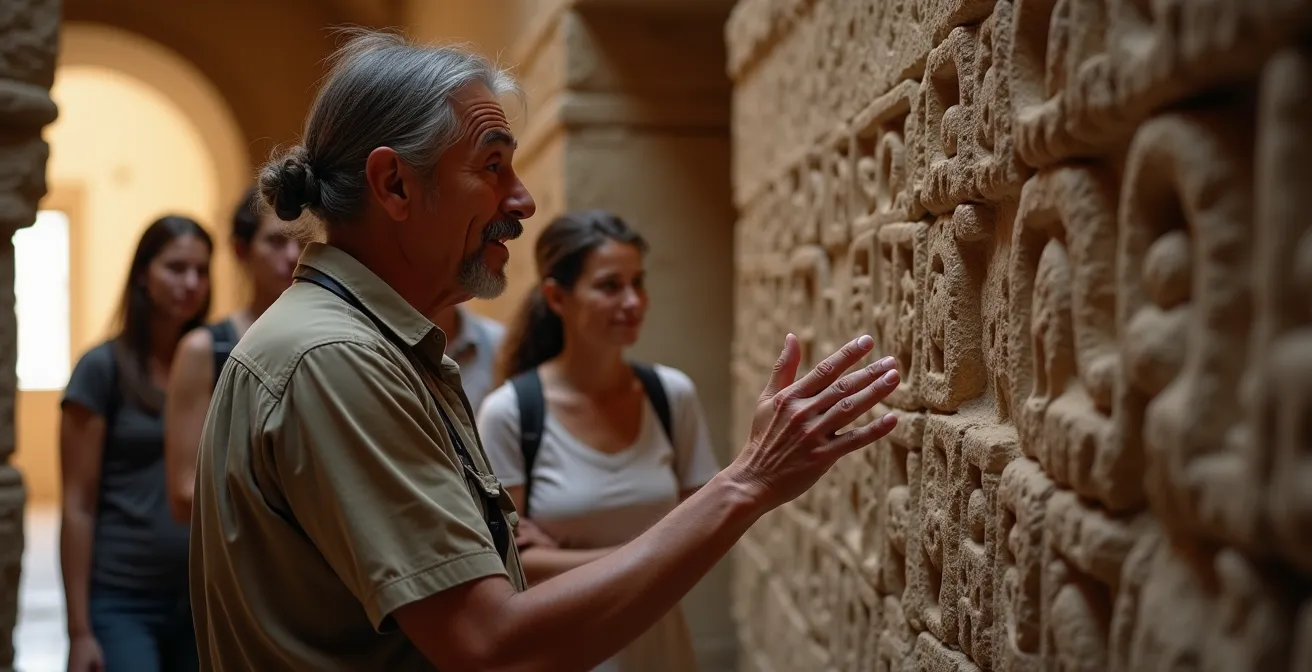
When you make contact, use a vetting questionnaire to gauge their expertise. Ask about common misconceptions they enjoy correcting, or a book that influenced their understanding of the site. Inquire about their specific area of specialization—be it social history, architecture, or water management. A true expert will respond with passion and detail, while a standard guide might give a generic answer. This process of finding a knowledge-bearer rather than a simple tour operator is crucial for unlocking the invisible fabric of a heritage site.
Here are some key questions to ask a potential guide to assess their depth of knowledge:
- “What’s a common misconception about this site you enjoy correcting?”
- “Can you recommend a book or article that deeply influenced your understanding of this place?”
- “What is your academic or research background specifically related to this site?”
- “Which aspect of the site’s history do you specialize in?”
- “Can you explain one recent archaeological discovery that changed our understanding of this site?”
Choosing a guide is choosing your lens for the day. A historian’s lens reveals a rich, complex, and living history, making your investment of time and money immeasurably more valuable.
Audio Guide vs Human Guide: Which Is Better for Complex Archaeological Sites?
The choice between a pre-recorded audio guide and a live human guide is a critical decision that shapes your experience, especially at vast or layered archaeological sites. There is no single right answer; the best choice depends on the nature of the site, your personal learning style, and your goals for the visit. Audio guides offer consistency, self-pacing, and often multilingual options. They are excellent for linear, well-preserved sites like a Roman villa, where the story unfolds in a clear sequence.
However, at sprawling, complex sites like Angkor Wat or Pompeii, an audio guide’s limitations become apparent. While it can provide detailed descriptions of individual buildings, it cannot help you navigate the immense space, connect disparate areas, or answer the spontaneous questions that arise from seeing something unexpected. This is where a human guide is irreplaceable. They provide navigational intelligence, contextualize the sheer scale of the place, and can tailor the narrative to your group’s interests, focusing more on military history or daily life as requested. The ability to ask “what’s that over there?” and get an insightful answer is a benefit technology cannot yet replicate.
A hybrid strategy is often the most effective. Many sites are integrating technology to enhance the visitor experience. In fact, a UNESCO collaboration with National Geographic confirms that 34 World Heritage sites now offer comprehensive digital experiences, including augmented reality (AR) that can visually reconstruct fallen structures. Using an AR-enabled guide for the visual “wow” factor while relying on a human guide for the storytelling, cultural nuances, and historical controversies can provide the richest possible experience. It combines the best of both worlds: technological immersion and human connection.
This matrix can help you decide which approach is best suited for the type of heritage site you plan to visit.
| Site Type | Audio Guide Benefits | Human Guide Benefits | Recommended Approach |
|---|---|---|---|
| Linear, well-preserved sites (e.g., Roman villa) | Self-paced exploration, multilingual options, consistent factual information | Can answer specific questions, adapt to group interests | Audio guide sufficient for basic visit |
| Vast, complex sites (e.g., Angkor Wat) | GPS-triggered content, detailed architectural descriptions | Navigation assistance, connecting disparate areas, contextualizing scale | Human guide essential |
| Sites with AR capabilities | Visual reconstructions, immersive historical overlays | Human stories, cultural nuances, controversy discussions | Hybrid strategy: AR for visuals + human for context |
Ultimately, select the tool—or combination of tools—that will best help you move beyond simply seeing the site to truly understanding it.
The disrespectful Selfie Behavior That Can Get You Banned from Sacred Temples
In our hyper-visual culture, the impulse to capture and share our experiences is powerful. Yet, at sacred and historical sites, this impulse can clash directly with the principles of respect and preservation. The “perfect selfie” has led to travelers sitting on fragile ancient walls, turning their backs on revered religious icons (a profound sign of disrespect in many cultures), or entering restricted areas, causing irreversible damage. This behavior stems from a mindset focused on “I was here” rather than “This is what I experienced.” It prioritizes personal branding over the sanctity of a shared global heritage.
As the Ethical Traveler Organization warns, the consequences of such behavior, multiplied by thousands of visitors, are severe. In their report on overtourism, they state:
Environmental degradation, damage to monuments or works of art, disruption of ecosystems, displacement of local people, and disruption of their access to their own historic or spiritual resources and traditions—all of these are potentially negative consequences that can arise as a result of too many visitors. In short, the symptoms of overtourism are sufficient to threaten the very existence and integrity of the sites being visited.
– Ethical Traveler Organization, Overtourism at UNESCO World Heritage Sites Report
The solution is not to ban photography, but to practice mindful observation and a more thoughtful approach to capturing images. Shift your focus from proving your presence to documenting what moves you. Instead of a selfie, practice observational photography. Focus your lens on the play of light on an ancient surface, the texture of weathered stone, or an architectural detail that tells a story. This approach encourages you to look more closely and connect more deeply with the environment.
Furthermore, always respect the “line of sacredness” by never turning your back on a Buddha statue or a sacred altar for a photo. Consider the digital impact as well; avoid geotagging specific, fragile locations and instead tag the broader city or region to prevent a deluge of visitors to a sensitive spot. By shifting your photographic goal from self-documentation to site-appreciation, you not only behave more respectfully but also create a more meaningful and unique visual record of your journey.
Let your photos tell the story of the place, not just the story of your being there. This change in perspective is a small act with a significant positive impact.
When to Visit Popular Ruins to Avoid the Cruise Ship Crowds?
Even with the best intentions, the sheer volume of visitors at popular sites can diminish the experience and strain the infrastructure. The serene, contemplative moment you envisioned can be shattered by a sea of selfie sticks and the chatter of a hundred simultaneous tours. Strategically timing your visit is not just about personal comfort; it is a form of conservation, helping to distribute the human footprint over time and reduce peak-hour pressure on fragile structures.
The rise in global travel is relentless. In a stark warning, UNESCO reports that international tourist numbers are expected to grow from 1.2 billion to 2 billion by 2030. This makes crowd-avoidance strategies more critical than ever. The most significant sources of concentrated crowds are often cruise ships and large bus tours, which operate on predictable schedules. Your first step should be to check the local port authority’s website for cruise ship schedules. Avoid visiting on days when multiple large ships are in port.
Beyond avoiding peak days, there are micro-timing strategies. Most tours follow a logical, linear path. Consider reverse-engineering the tour route, starting at the typical exit and moving backward against the flow of traffic. Another effective tactic is to exploit the “mid-day lull.” Large morning tour groups often depart for lunch between 12:30 PM and 2:00 PM, creating a precious window of relative quiet before the afternoon wave arrives. The most dedicated seekers of solitude should aim to book the very first or very last entry slots of the day, a time when the light is often most beautiful and the crowds are at their thinnest.
Here are some key timing techniques:
- Check Port Authority Websites: Identify peak cruise ship arrival days.
- Exploit the ‘Mid-Day Lull’: Visit between 12:30 PM and 2:00 PM.
- Reverse-Engineer Tour Routes: Start at the end and move backward.
- Travel During Shoulder Season: Visit in off-peak months for drastically fewer visitors.
- Book First or Last Entry Slots: Secure the earliest or latest time slots for a more peaceful experience.
A little planning allows you to experience these magnificent sites as they were meant to be experienced: with a sense of wonder and peace.
When to Visit Nesting Sites to Observe Without Disrupting the Animals?
The principles of intentional stewardship extend beyond stone ruins to the living, breathing wonders of our planet’s natural heritage sites. When observing wildlife, especially at sensitive nesting or breeding grounds, our presence is far more impactful than we might realize. The goal of ethical wildlife observation is to be an invisible witness, never an active participant or a source of stress for the animals.
The most critical concept to understand is the “flight initiation distance”—the invisible boundary around an animal that, when crossed, triggers a flight or stress response. Your primary tool for respecting this boundary is not your feet, but your optics. High-quality binoculars and telephoto lenses are not luxuries; they are essential instruments of respect. They allow you to get a “close-up” view without causing the animal to expend precious energy fleeing or abandoning its young. As a simple guideline, follow the “rule of thumb”: if you can cover the entire animal with your thumb held at arm’s length, you are likely at a respectful distance.
Timing your visit is also crucial. Research the local breeding and nesting seasons. Visiting outside these critical periods, when animals are most vulnerable and easily disturbed, is the most responsible choice. If you must visit during these times, learn to recognize distress signals: alarm calls, birds faking a broken wing to lure you away from a nest, fixed staring, or flattened ears. These are clear signs that you are too close. Finally, be a discerning consumer. Avoid “baited” tours that use food, calls, or other artificial means to guarantee a sighting. This practice disrupts natural behaviors and creates a dangerous dependency on humans. A genuine encounter with wildlife on its own terms is infinitely more rewarding. This approach is exemplified by initiatives like the Palau Pledge, a community-driven conservation success at the Rock Islands Southern Lagoon World Heritage site, where all visitors commit to respecting the environment, demonstrating that simple, enforced regulations can powerfully protect a natural landscape.
Your reward is the profound privilege of witnessing a moment of wild, untroubled life, a memory far more valuable than any close-up photo.
The “Aging” Techniques Scammers Use to Fake Antiques
A core part of supporting heritage is ensuring your tourist dollars support authentic culture, not fraudulent industries that exploit it. When browsing markets near historical sites, the allure of taking home a piece of history is strong. However, this desire fuels a thriving market for fake antiquities, where scammers use sophisticated techniques to make modern reproductions look ancient. Being able to spot a fake is not just about protecting your wallet; it’s about refusing to participate in a market that devalues genuine artifacts and can sometimes be linked to the illegal antiquities trade.
Scammers have a toolbox of “aging” methods. One of the most common is the tea stain test. Objects are soaked in tea or coffee to give them a uniform brown patina that mimics age. Genuine aging is rarely so even. Another method involves tumbling new carvings with rocks in a machine to create chips and wear. Look for evenly distributed, repetitive damage, which is a red flag compared to the random, varied wear of a genuinely old object.
The material and tool marks are also giveaways. Modern power tools leave behind perfectly round drill holes or parallel lines that would be impossible to create with ancient tools. Feel the weight of the object; artificially aged items made from modern materials or rapidly dried clay often feel lighter than their authentic counterparts. Finally, for more valuable pieces, a small, portable UV light can be a powerful tool. Many modern adhesives, paints, and treatments will fluoresce brightly under UV light, revealing a recent creation masquerading as an ancient one.
Action Plan: How to Spot a Fake Antique
- Tea Stain Test: Look for uniform brown coloring that suggests tea or coffee soaking rather than natural, uneven aging.
- Tumble Marks: Check for evenly distributed chips and wear patterns that indicate artificial tumbling with rocks.
- Patina Analysis: Examine the surface. A fake patina often appears uniform and powdery, whereas genuine oxidation is multi-hued and integrated with the material.
- Tool Mark Investigation: Search for signs of modern tools, such as perfectly round drill holes or parallel lines from power sanders.
- UV Light Check: Use a portable UV light. Many modern adhesives, paints, and fillers will fluoresce, revealing the item is not genuinely old.
By learning to recognize these red flags, you can make informed purchasing decisions that support living artisans creating authentic crafts, rather than funding a deceptive trade.
Key Takeaways
- Preparation is Preservation: The most important part of your visit happens before you leave. Researching a site’s history and cultural context is an act of respect that transforms your entire experience.
- Your Choices Have an Impact: Every decision, from the guide you hire to the time you visit and the photos you take, directly affects the site’s integrity and the local community.
- Support Genuine Conservation: True stewardship means ensuring your financial contributions support authentic local culture and verified conservation efforts, not exploitative or fraudulent enterprises.
Which Eco-Lodges Actually Contribute More than 50% to Local Conservation?
“Ecotourism” and “sustainability” have become marketing buzzwords, making it incredibly difficult to distinguish genuine conservation-focused lodges from those engaged in greenwashing. A truly sustainable lodge does more than just ask you to reuse your towels; it functions as an integral part of the local conservation ecosystem. This is especially critical in areas surrounding natural World Heritage sites, where tourism pressure can be immense. As a stark reminder of the stakes, UNESCO Director-General Audrey Azoulay warns that one-third of natural World Heritage Sites and one-fifth of cultural sites are currently under severe threat due to global warming and other pressures.
So how do you verify a lodge’s claims? It requires due diligence. Start by asking for proof. A genuinely committed eco-lodge should be able to provide a transparency or annual impact report detailing their contributions. Vague claims of “supporting the community” are not enough. Ask for specifics: “Which named local conservation projects do you financially or logistically support?” or “What percentage of your management staff is from the local community?” A legitimate operation will answer with pride and detail. For example, the ‘cash for work’ programme led by UNESCO in Angkor, Cambodia, supported the restoration of community boat tours, creating 40 new jobs and helping to disperse visitor impact—a clear, measurable outcome.
Investigate the ownership structure. Look for lodges that are community-owned, co-managed, or have clear benefit-sharing agreements. This ensures that profits are funneled back into the local economy and conservation initiatives, rather than to distant corporations. Finally, if a lodge boasts certifications, take a moment to cross-check them. Look up the certifying body (like Green Globe or Fair Trade Tourism) and, if possible, search for community testimonials or independent reviews that speak to the lodge’s local impact. This legacy-aware travel approach ensures your accommodation choice is an active investment in the future of the heritage you came to see.
Use this checklist to perform your own due diligence:
- Request Transparency Reports: Ask directly for their latest impact report.
- Verify Local Support: Inquire about the specific, named projects they support.
- Check Employment Practices: Ask what percentage of management is local.
- Investigate Ownership Structure: Look for community co-ownership or benefit-sharing.
- Verify Certification Claims: Cross-check certifications with the issuing body and look for independent verification.
Begin planning your next journey not just as a trip, but as a conscious act of preservation. Your choices are powerful tools for protecting our shared global heritage for all future generations.