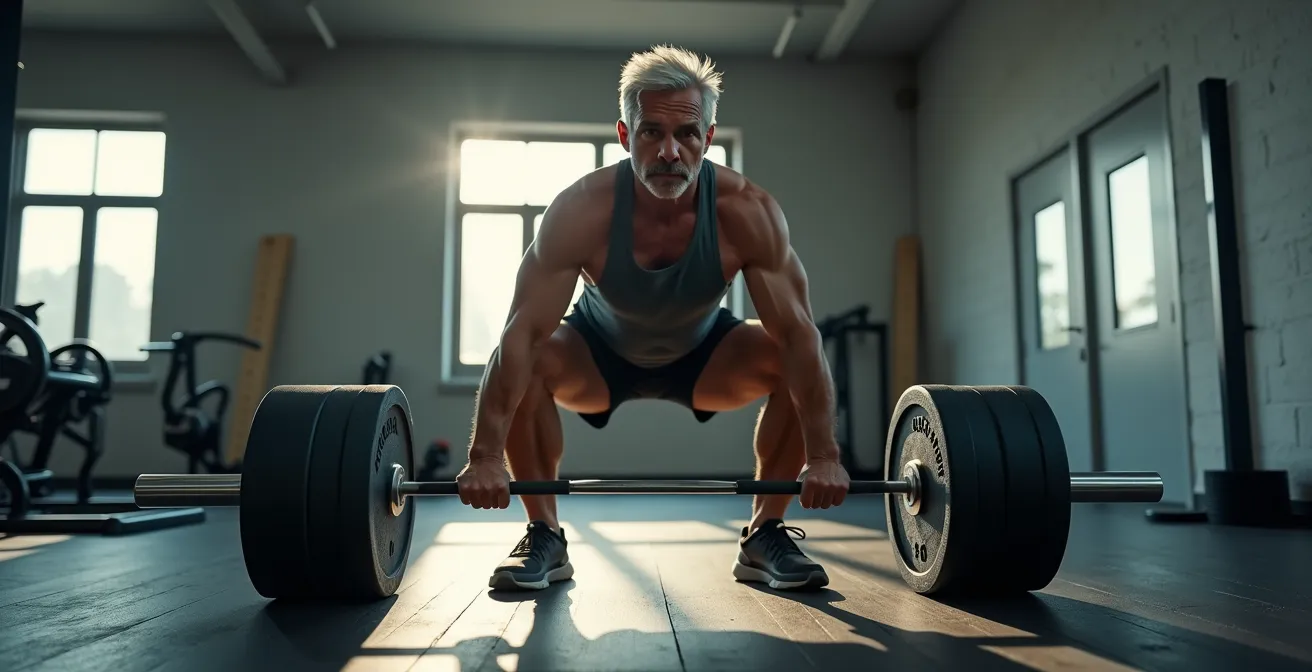
Functional strength is more critical than cardio after 40 because it directly rebuilds your ability to perform real-world tasks and is a powerful predictor of longevity.
- Objective measures like grip strength are a better predictor of long-term health and mortality risk than many cardiovascular metrics.
- Mastering fundamental movement patterns (like the squat) protects your joints during daily activities and combats the damage of a sedentary lifestyle.
Recommendation: Focus on mastering fundamental movements (push, pull, squat, hinge) with 2-3 focused workouts a week for sustainable, lifelong capability.
If you’re over 40, you might have noticed a subtle shift. The grocery bags feel a bit heavier, getting up from a low chair requires a little more effort, and the thought of chasing after a rolling suitcase feels more daunting than it used to. The conventional wisdom for decades has been to double down on cardio—more running, more cycling, more time on the elliptical. We’ve been taught that a healthy heart is the cornerstone of healthy aging. While cardiovascular health is undeniably important, this focus often misses a more fundamental point about what it means to live well and independently for longer.
The real challenge isn’t just about your heart’s endurance; it’s about your body’s structural integrity and its ability to interact with the world. It’s about having the strength to lift a grandchild, the balance to avoid a fall on an icy sidewalk, and the mobility to travel and explore without pain. What if the true key to a vibrant, capable life in your 50s, 60s, and beyond isn’t about how fast you can run, but about how well you can move? This is the core of functional strength training: a philosophy that prioritizes building a body that is resilient, capable, and ready for the demands of real life.
This article will shift your perspective away from just “exercise” and toward the concept of building “physical autonomy.” We’ll explore why specific strength metrics are powerful predictors of longevity, how to correct fundamental movements to protect your body, and how to design efficient workouts that build real-world capability, not just gym-specific strength. It’s time to train for life.
For those who prefer a visual summary, the following video provides a great 15-minute introduction to the types of exercises that build foundational strength, complementing the principles discussed in this guide.
To guide you through this new approach to fitness, we have structured this article to address the most critical components of functional strength for long-term health. Each section tackles a key aspect of building a more capable and resilient body after 40.
Summary: Rebuilding a Capable Body for Lifelong Vitality
- Why Grip Strength Is the #1 Predictor of Longevity in Seniors?
- How to Fix Your Squat Form to Save Your Knees When Sitting Down?
- Machines vs Free Weights: Which Builds Better Balance for Real Life?
- The “Glute Amnesia” Problem Caused by Sitting All Day
- How to Design a 20-Minute Workout That Covers Push, Pull, Squat, and Hinge?
- How to Configure Your Desk Setup to Prevent Chronic Back Pain?
- How to Do Low-Impact HIIT That Saves Your Knees?
- The “More Is Better” Mistake That Leads to Burnout in HIIT Workouts?
Why Grip Strength Is the #1 Predictor of Longevity in Seniors?
When we think of markers for a long and healthy life, we often consider blood pressure, cholesterol levels, or cardiovascular endurance. However, a growing body of research points to a much simpler, yet profoundly telling, indicator: the strength of your grip. This isn’t just about opening a stubborn jar; it’s a direct window into your overall muscular integrity, nervous system health, and resilience. A weak grip is often a symptom of a body-wide decline in muscle mass and function, a condition known as sarcopenia, which is a major risk factor for frailty and loss of independence.
The data is startling. A comprehensive 2024 meta-analysis in *Nature Scientific Reports* confirmed that for every 5kg decrease in grip strength, there is an associated 16-20% increase in all-cause mortality risk. This correlation is so strong that the landmark PURE study, which followed 140,000 adults, found that grip strength was a more reliable predictor of cardiovascular death than systolic blood pressure. It acts as an inexpensive, powerful proxy for your body’s overall “structural integrity.” A strong grip signifies a robust neuromuscular system, better bone density, and a greater capacity to handle the physical stressors of daily life.
Improving your grip is not about endless sets of wrist curls. It’s about integrating it into your functional training. Exercises like farmer’s walks (carrying heavy weights for distance), dead hangs from a pull-up bar, and heavy rows all build a powerful, useful grip. This is a perfect example of capability-focused training: the goal isn’t just a stronger hand, but a more capable and resilient body that can confidently carry heavy groceries, lift a suitcase, or catch itself from a fall.
How to Fix Your Squat Form to Save Your Knees When Sitting Down?
The squat is arguably the most fundamental human movement pattern. We do it dozens of times a day without thinking: getting up from a chair, picking something off the floor, or sitting down on the toilet. Yet, years of sitting in chairs and a lack of conscious movement often lead to poor squat mechanics, placing undue stress on the knees and lower back. For anyone over 40 experiencing knee pain, the solution isn’t to avoid squatting, but to re-learn how to do it correctly. A proper squat is a hip-dominant movement, not a knee-dominant one, protecting your joints for a lifetime of use.
The key is to initiate the movement by sending your hips backward, as if you’re about to sit in a chair that’s slightly too far behind you. Your chest should stay up, and your weight should be distributed evenly across your feet. The knees should track in line with your toes, not cave inward. This simple shift in technique transforms the squat from a knee-straining exercise into a powerful builder for your glutes and hamstrings—the true engines of your lower body. By strengthening these muscles, you create a support system that offloads stress from the knee joint.
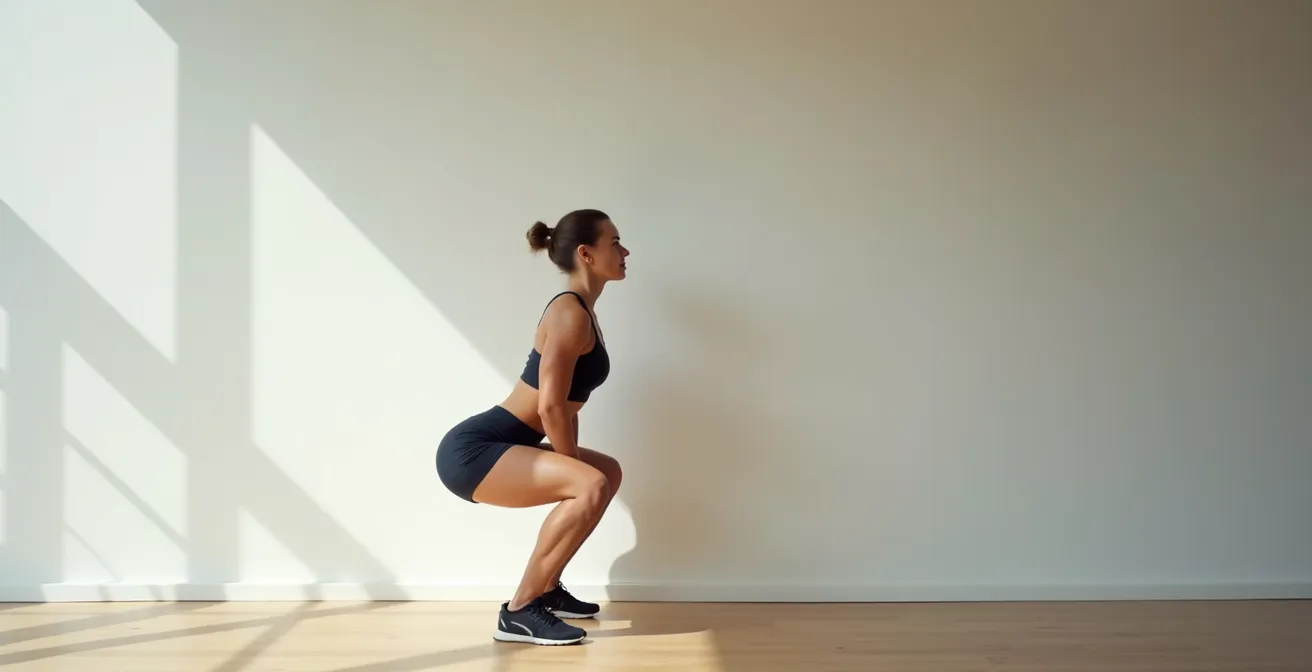
As you can see in the demonstration, a proper bodyweight squat maintains a proud chest and ensures the hips drop back and down, keeping the knees from traveling excessively forward. This preserves your “movement vocabulary,” ensuring that one of life’s most essential actions remains pain-free and efficient. Before adding any weight, mastering this form is non-negotiable for longevity.
Action Plan: Your Squat Self-Assessment
- Ankle Mobility Check: Film yourself squatting from the side. If your heels lift off the ground as you descend, it’s a sign of tight calves. Focus on daily calf stretches and ankle mobility drills to improve your range of motion.
- Knee Tracking Test: Squat facing a mirror. If your knees cave inward (valgus collapse), it indicates weak glute medius muscles. Integrate exercises like clamshells and lateral band walks to strengthen these crucial hip stabilizers.
- Hip Hinge Assessment: If you find yourself bending at the knees first instead of pushing your hips back, your hip flexors may be tight. Prioritize hip mobility work and practice the “hip hinge” movement with a dowel on your back to learn the pattern.
- Tempo Control Practice: Build protective strength by slowing down. Practice a controlled 3-second descent (the eccentric phase) on every repetition. This builds muscle and reinforces proper neuromuscular control, safeguarding your knees.
Machines vs Free Weights: Which Builds Better Balance for Real Life?
Step into any commercial gym, and you’ll see a clear divide: a section of shiny, fixed-path machines and an area with racks, barbells, and dumbbells. For those over 40, the machines can feel safer and less intimidating. They guide the movement, reducing the perceived risk of injury. However, this safety comes at a cost: it robs you of the opportunity to build one of the most critical components of functional fitness—internal stability and balance.
Machines provide external stability. The leg press machine, for example, holds you in place, allowing you to push heavy weight but doing nothing to train the hundreds of small stabilizer muscles in your core, hips, and ankles that are essential for real-world balance. Free weights, on the other hand, force your body to create its own stability. A simple dumbbell goblet squat requires your nervous system to fire on all cylinders, coordinating muscles throughout your body to keep you upright and in control. This high level of neuromuscular engagement is what directly translates to being more stable on your feet when you encounter an uneven sidewalk or have to quickly shift your balance.
This table breaks down the fundamental differences in how these two modalities contribute to your physical autonomy.
| Factor | Machines | Free Weights |
|---|---|---|
| Stability Type | External (provided by equipment) | Internal (created by body) |
| Nervous System Activation | Minimal proprioceptive demand | High neuromuscular engagement |
| Real-World Transfer | Limited functional carryover | Direct application to daily activities |
| Best Use Case (40+) | Building baseline strength post-injury | Developing balance and coordination |
| Progression Path | Gateway to free weight training | Advanced unilateral variations |
While machines have a place, especially for safely isolating muscles or during post-injury rehabilitation, the bulk of a longevity-focused program should center on free weights. Furthermore, progressing to unilateral (single-arm or single-leg) exercises with free weights is even more effective. An 8-week study found that incorporating single-leg deadlifts and single-arm presses improved balance scores by 35% more than traditional bilateral exercises, significantly enhancing core stability and reducing fall risk.
The “Glute Amnesia” Problem Caused by Sitting All Day
One of the most pervasive, yet under-recognized, consequences of a modern desk-bound lifestyle is a condition often called “glute amnesia.” This isn’t about your glute muscles physically wasting away (though that can happen); it’s a neuromuscular issue where your brain essentially “forgets” how to activate them properly. After spending hours a day sitting, the hip flexors at the front of your body become chronically tight and shortened. This sends a constant signal to the nervous system that actively inhibits, or “turns off,” the opposing muscle group: the glutes. This phenomenon is known as reciprocal inhibition.
When your glutes aren’t firing correctly, your body is forced to compensate. Instead of using these powerful hip extensors for tasks like climbing stairs, getting up from a chair, or lifting objects, you start over-relying on your hamstrings and lower back. This is a direct pathway to chronic low back pain, hamstring strains, and knee issues. The glutes are the powerhouse of your body, designed to provide stability to the pelvis and generate force. When they’re “asleep,” your entire kinetic chain is compromised.
The first step to reversing glute amnesia is not to immediately start doing heavy squats. It’s to follow a deliberate activation protocol. This typically involves three phases:
- Release: Use a foam roller or lacrosse ball on your tight hip flexors to reduce the inhibitory signals they’re sending.
- Activate: Perform simple, low-load exercises like glute bridges and clamshells, focusing intensely on squeezing the glute muscles to re-establish the mind-muscle connection.
- Integrate: Finally, perform compound movements like bodyweight squats and lunges, consciously focusing on driving the movement with your newly awakened glutes.
This systematic approach provides the necessary neuromuscular re-education to restore proper function and build a more resilient foundation.
How to Design a 20-Minute Workout That Covers Push, Pull, Squat, and Hinge?
The belief that you need to spend an hour or more in the gym to get results is a major barrier for busy adults. The reality, especially for those focused on longevity and capability, is that consistency trumps duration. A short, well-designed, full-body workout performed 2-3 times a week is far more effective than one heroic, exhausting session. The key is to focus on the four primary human movement patterns: push, pull, squat, and hinge. Covering these patterns ensures you’re training your body in a balanced way that translates directly to real-world strength.
A “push” movement involves pushing weight away from your body (e.g., a push-up). A “pull” involves pulling weight toward you (e.g., a dumbbell row). The “squat” pattern trains your ability to lower your center of gravity (e.g., a goblet squat), and the “hinge” trains your ability to bend at the hips while maintaining a neutral spine (e.g., a kettlebell swing or Romanian deadlift). By selecting one exercise from each category, you can create an incredibly efficient and effective full-body workout.
A simple and powerful framework for a time-crunched session is the “5-12-3” formula:
- 5 Minutes Dynamic Warm-Up: Prepare your body for movement with joint circles (ankles, hips, shoulders), leg swings, and light, un-weighted versions of the exercises you’re about to perform.
- 12 Minutes High-Intensity Work: Perform 3 rounds of a 4-exercise circuit. A great example is Push-ups, Bent-Over Rows, Goblet Squats, and Romanian Deadlifts. Work for 45 seconds on each exercise, followed by a 15-second transition to the next.
- 3 Minutes Recovery Cool-Down: Bring your heart rate down and promote recovery with deep breathing and static stretches for the major muscle groups you just worked, such as the chest, back, and hamstrings.
This 20-minute structure delivers the “minimum effective dose” needed to stimulate muscle growth, improve strength, and reinforce your functional movement vocabulary without causing excessive fatigue or requiring a huge time commitment.
How to Configure Your Desk Setup to Prevent Chronic Back Pain?
While a 20-minute workout is potent, its benefits can be undermined if you spend the other 23 hours of your day in positions that damage your body. The modern desk setup is a primary culprit for chronic back pain, tight hips, and poor posture. The goal is not just to find the “perfect” ergonomic chair, but to create an environment that encourages movement and breaks up long periods of static posture. Your best posture is your next posture.
Start by ensuring your basic setup follows the 90-degree rule: elbows, hips, and knees should all be at roughly 90-degree angles, with your feet flat on the floor. Your monitor should be positioned so the top of the screen is at or slightly below eye level, preventing you from craning your neck forward. However, the most powerful ergonomic intervention is not static—it’s dynamic. A standing desk is a fantastic tool, not because standing all day is superior to sitting all day, but because it gives you the option to easily change positions.
The ultimate strategy is to pepper your workday with “movement snacks”—short, simple exercises that reverse the negative effects of sitting. These micro-breaks keep your muscles activated, your joints lubricated, and your nervous system engaged. They are a non-negotiable part of a functional approach to health.
- Every 30 minutes: Perform 10 Chair Squats. Focus on standing up and sitting down with control, using your glutes rather than momentum.
- Every hour: Do a 30-second Desk Plank. Place your hands on your desk, walk your feet back, and hold a strong plank position to activate your core.
- Every 2 hours: Perform standing hip flexor stretches, holding each side for 30 seconds to counteract the shortening that occurs from sitting.
By integrating these small habits, you transform your workday from a source of physical decay into an opportunity for continuous, low-level restoration.
How to Do Low-Impact HIIT That Saves Your Knees?
High-Intensity Interval Training (HIIT) is renowned for its efficiency in improving cardiovascular fitness and boosting metabolism. However, for many people over 40, traditional HIIT workouts filled with burpees, box jumps, and high-knee running can be a recipe for joint pain, particularly in the knees. The good news is that “high-intensity” does not have to mean “high-impact.” You can achieve the same physiological benefits by choosing exercises that challenge your muscles and cardiovascular system without punishing your joints. Intensity is a measure of effort, not impact.
The key is to select movements that are based on power and resistance rather than jumping. This approach allows you to elevate your heart rate to the desired zone (typically 80-90% of your max) while keeping your feet firmly connected to the ground or a stable surface. This makes your training sustainable and significantly reduces the risk of the overuse injuries that can derail your progress.
Here are some excellent zero-impact exercises that are perfect for a knee-friendly HIIT workout:
- Kettlebell Swings: This powerful hip hinge movement is a full-body cardio and strength exercise that builds explosive power with zero impact on the knees.
- Battle Ropes: Performing waves, slams, or circles with battle ropes is an incredible upper-body and core challenge that will spike your heart rate in seconds.
- Sled Push/Drag: Pushing or dragging a weighted sled is a form of strength-based cardio that builds tremendous leg power and endurance without any jarring forces.
- Farmer’s Walks: Simply picking up two heavy dumbbells or kettlebells and walking as fast as you can for 30-60 seconds is a surprisingly brutal and effective full-body conditioning tool.
A study comparing training based on heart rate zones to Rate of Perceived Exertion (RPE) found that over-40 participants using RPE reported less joint discomfort and had 23% better adherence, achieving similar fitness gains. This underscores the importance of listening to your body and choosing exercises that feel challenging but safe.
Key takeaways
- Prioritize movement quality over sheer quantity or load; how you move is more important than how much you lift.
- True functional strength is the foundation for balance, coordination, and the physical autonomy needed for daily life.
- Treat high-intensity training as a “medicinal dose” — use it strategically and prioritize recovery to avoid burnout and injury.
The “More Is Better” Mistake That Leads to Burnout in HIIT Workouts?
In our goal-oriented culture, it’s easy to fall into the “more is better” trap. If one HIIT session is good, three must be better, and five must be best. This approach might work in your twenties, but for anyone over 40, it’s a direct path to burnout, injury, and diminishing returns. As we age, our recovery capacity changes. Hormonal shifts and cumulative wear and tear mean that our bodies need more time to repair and adapt to the stress of intense exercise. Ignoring this reality is the single biggest mistake people make when trying to get fit after 40.
The magic of training doesn’t happen during the workout; it happens during the recovery period afterward. Intense exercise is a stressor that breaks down muscle tissue. The strength and fitness gains come when your body rebuilds that tissue stronger than before. If you repeatedly apply that stress without allowing for adequate recovery, you never enter the rebuilding phase. Instead, you accumulate fatigue, inflammation, and stress hormones like cortisol, which can lead to muscle loss, fat gain, and a weakened immune system. For this reason, evidence-based fitness research demonstrates that 1-2 HIIT sessions per week is often the optimal frequency for adults over 40 to maximize benefits while allowing for full recovery.
This is where the wisdom of a longevity coach comes in. It’s about shifting from a mindset of “crushing it” every day to one of strategic application. As Dr. Joel Seedman, a PhD in Kinesiology, aptly puts it:
For longevity and vitality after 40, HIIT should be treated as a ‘medicinal dose’ tool – powerful when used correctly but harmful in excess.
– Dr. Joel Seedman, Advanced Human Performance
Your other training days should be focused on lower-intensity strength work, mobility, or active recovery like walking or stretching. This balanced approach is the true secret to building sustainable, lifelong fitness and physical autonomy.
By shifting your focus from endless cardio to building a foundation of functional strength, you are not just exercising; you are investing in your future self. You are building the physical autonomy to live a life full of vitality, confidence, and independence for decades to come. To begin applying these principles, the next logical step is to assess your own fundamental movement patterns and create a balanced, sustainable training plan.