
For frequent renters, modular furniture is the only financially and logistically sound choice, transforming a recurring expense into a long-term, adaptable asset.
- It drastically cuts long-term costs by eliminating the need for replacements and minimizing professional moving fees with each new lease.
- Its inherent adaptability supports evolving life and work needs, allowing your space to change without buying new furniture.
Recommendation: When planning your next move, shift your mindset from initial purchase price to the total lifecycle cost of your furniture.
Every renter knows the feeling: the sinking dread of moving a bulky, traditional sofa. Pivoting it through a narrow doorway, scraping it against a stairwell wall, or worse, realizing it simply won’t fit in the new living room layout. This often leads to a frustrating and expensive cycle: buy, use for a short time, sell at a loss (or abandon on the curb), and repeat. It’s a system that treats furniture as a disposable good, a sunk cost tied to a single address.
The common advice is to buy cheap, temporary pieces, but that only reinforces the waste. The real problem isn’t the furniture itself, but our perception of it. What if, instead of a liability, your furniture could be a strategic asset that moves and evolves with you? This is the core principle of modular design. It’s a shift away from static, single-purpose items toward an intelligent, adaptable system that offers true long-term value.
This article moves beyond the simple idea of “flexibility.” We will deconstruct the financial, practical, and spatial logic that makes modular furniture the superior choice for a nomadic lifestyle. We’ll analyze the total cost of ownership, explore how to plan for future needs, and identify the critical quality markers that separate a lasting investment from a short-lived frustration. It’s time to stop furnishing for the apartment you have and start investing in a system that works for every apartment you’ll ever have.
To fully understand this strategic shift, this guide will break down the key advantages, from concrete financial savings to the practicalities of reconfiguring your space for any layout life throws at you. Explore the sections below to build your case for a smarter way of living.
Summary: The Renter’s Complete Guide to Modular Furniture
- Why Buying Modular Furniture Saves You $2,000 Over 5 Years?
- How to Reconfigure Your Shelving Unit for a New Room Layout?
- Convertible Crib vs Standard Crib: Which Offers Better Value for New Parents?
- The Connector Failure That Ruins Cheap Modular Couches in 12 Months
- How to Plan a Living Room Layout That Accommodates Future Modules?
- L-Shape vs Parallel Layout: Which Works Best for a Home Office/Guest Room?
- How to Pack Ceramic Art so It Survives a Transatlantic Flight?
- How to Optimize Small Living Spaces Without Sacrificing Functional Flow?
Why Buying Modular Furniture Saves You $2,000 Over 5 Years?
The initial price tag of a quality modular sofa can seem higher than a traditional one, leading many renters to opt for the cheaper, static option. This is a classic false economy. The true cost of furniture isn’t the day-one purchase price; it’s the total lifecycle cost, especially for someone moving every two years. This includes costs of moving, disposal fees for furniture that doesn’t fit a new space, and the price of inevitable replacements.
Traditional furniture is a logistical and financial burden. The expense of moving a two-bedroom home’s furniture can range from $2,000 to $7,000 for a cross-country move, with bulky items like sofas contributing significantly to that cost. A modular sofa, however, breaks down into manageable pieces, drastically reducing or even eliminating the need for professional movers for that specific item. This alone can represent hundreds of dollars in savings per move.
The real savings, however, come from avoiding the replacement cycle. When a traditional sofa doesn’t fit a new apartment’s layout, the owner faces a steep loss, either through low resale value or disposal costs. A modular sofa simply reconfigures. As the following comparison demonstrates, the long-term financial advantage is undeniable.
| Cost Category | Traditional Sofa | Modular Sofa |
|---|---|---|
| Initial Purchase | $1,500 | $2,000 |
| Moving Costs (2 moves) | $700-$1,000 | $200-$300 |
| Disposal/Resale Loss | $800 | $0 |
| Replacement for New Space | $1,500 | $0 (reconfigure) |
| Total 5-Year Cost | $4,500-$4,800 | $2,200-$2,300 |
Case Study: The Long-Term Durability Test
In a 2025 review, Living Cozy tested ten popular modular sofas, finding that top brands like Albany Park and 7th Avenue not only offered tool-free assembly in under 15 minutes but were engineered for longevity. Their findings showed that quality systems with features like water-repellent fabrics and memory foam cushions are designed to last over a decade, easily adapting to multiple moves without needing replacement, validating their value as a long-term asset.
How to Reconfigure Your Shelving Unit for a New Room Layout?
The beauty of modularity extends far beyond the sofa. Shelving systems, in particular, unlock a level of spatial agility that is impossible with traditional bookcases. For a renter, a modular shelving unit is not just a place to store books; it’s a dynamic architectural element. In one apartment, it might be a sprawling, wall-to-wall media center. In the next, a smaller space might demand it be broken into two separate, smaller bookcases. In a studio, it can even become a room divider, creating the illusion of separate zones for living and sleeping.
The process of reconfiguration is designed for simplicity. It begins with a mental blueprint. Before you move a single piece, measure your new space and sketch out the desired configuration. Do you need a tall, narrow tower to fit an alcove, or a low, wide console under a window? This planning phase prevents unnecessary trial and error.
Next, disassemble the unit. Most modern modular systems use simple, tool-free connectors like pins, clips, or pressure fittings. Lay out all the components—shelves, uprights, and connectors—so you have a clear inventory. Then, begin assembling the new configuration, starting from the base and working your way up. Always ensure the unit is stable, especially if creating a taller structure, and use any included wall-anchoring hardware for safety.
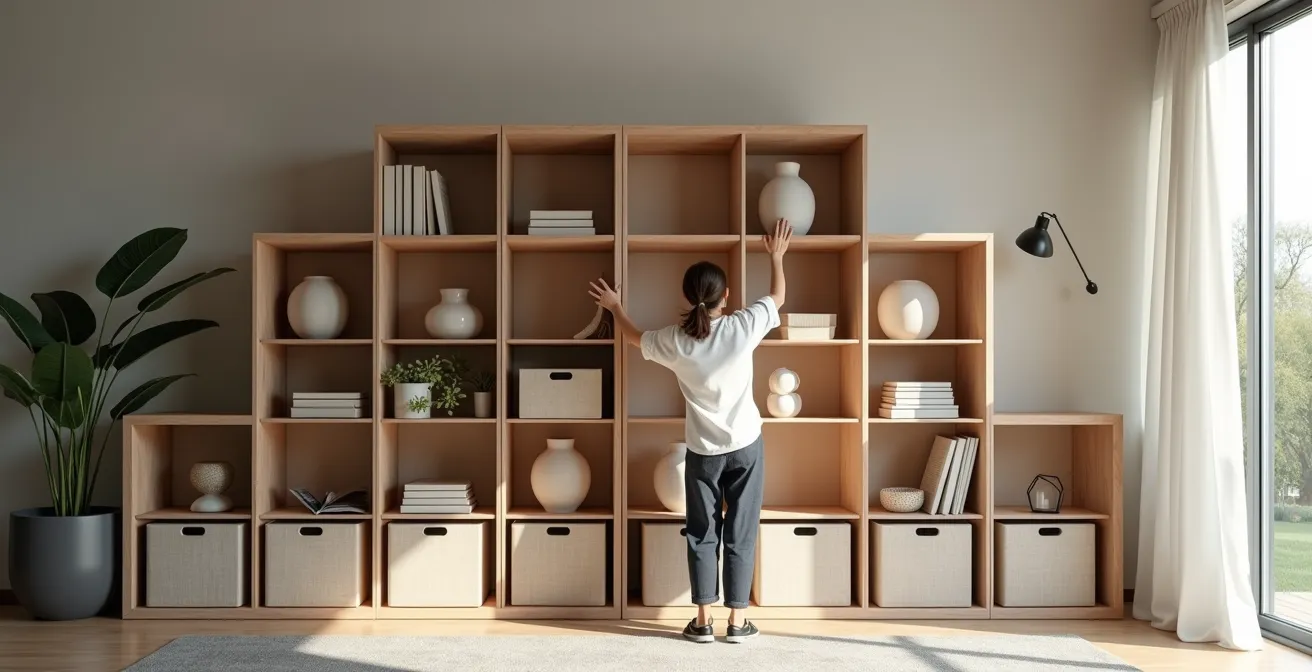
As this visualization shows, the same set of components can serve radically different functions. This ability to transform storage from a static wall unit into an open, airy room divider is a game-changer for renters. It means you are investing in a system that guarantees a perfect fit for any room, rather than a piece of furniture that dictates how you can use your space.
Convertible Crib vs Standard Crib: Which Offers Better Value for New Parents?
For renters starting a family, the logic of modularity becomes even more critical. A new baby brings joy, but also a cascade of short-term, single-use furniture. The standard crib is a perfect example: essential for the first two years, then quickly outgrown and destined for storage or resale at a significant loss. This adds to the already high cost of outfitting a home for a growing family. When a move is factored in, the logistics of transporting a bulky crib, toddler bed, and eventually a twin bed become a recurring headache.
A convertible crib applies the modular principle to this challenge. It is designed as a multi-stage system: it begins as a high-sided infant crib, then transforms. By removing a side panel, it becomes a toddler bed with a safety rail. Later, it can convert into a daybed for a young child, and finally, with a full conversion kit, into a headboard and footboard for a full-size bed. This single purchase can potentially serve a child from birth through their teenage years.
For a family that anticipates moving, the value is immense. Instead of buying, moving, and disposing of three or four different beds over a decade, they move one adaptable system. The higher upfront cost is quickly offset by the elimination of future purchases and the simplified logistics of each move. It embodies the same smart principle as a modular sofa: invest once in a system that grows with your life, rather than repeatedly buying disposable items that fit only one specific moment in time.
The Connector Failure That Ruins Cheap Modular Couches in 12 Months
Not all modular sofas are created equal. The single greatest point of failure—and the reason some people are wary of the category—is the quality of the connectors. A cheap modular sofa might look great on day one, but after a few months of use, the dreaded “module drift” begins. Sections slowly separate, creating an annoying and unsightly gap. This is a direct result of poor system integrity, where flimsy plastic clips or weak stamped-metal brackets stretch, crack, or fail to lock securely.
High-quality modular systems, in contrast, are over-engineered at this critical junction. They use robust hardware, such as heavy-duty steel “alligator” clips, interlocking brackets, or solid steel pins that ensure a rigid, unified connection. These systems are designed to withstand the stress of daily use and, just as importantly, the repeated cycles of assembly and disassembly that a renter’s lifestyle demands. As the Living Cozy review team noted, this is a defining feature of a well-made product.
The modular system stays firmly connected, preventing shifting — a common issue with lesser modular sofas — while still giving you the freedom to reconfigure as needed.
– Living Cozy Review Team, The 10 Best Modular Sofas of 2025
The difference in material and design is stark. A robust steel connector provides a mechanical lock that feels solid, while a cheap plastic alternative relies on friction and is prone to fatigue. Before purchasing any modular sofa, it is essential to investigate the connection system with the same scrutiny you would apply to the frame or fabric.

Your Pre-Purchase Durability Checklist
- Connector Material: Ask the salesperson or check specs for the exact composition (solid steel is ideal; avoid all-plastic).
- The Lift Test: In the showroom, try to lift one corner of a connected module; look for any flex, wobble, or give at the connection point.
- Locking Mechanism: Inspect the hardware. Look for heavy-duty, interlocking metal parts like alligator clips or substantial brackets, not just simple friction-fit pieces.
- Warranty Check: Read the warranty fine print. Does it specifically cover connector failure or structural integrity over time?
- Review Focus: Seek out long-term reviews (12+ months) and specifically search for mentions of “shifting,” “gaps,” or “separation.”
How to Plan a Living Room Layout That Accommodates Future Modules?
Buying a modular sofa isn’t just a purchase; it’s the start of a long-term relationship with your furniture. The smartest approach is to plan not only for your current space but also for your future needs. This means thinking about how your sofa can expand or change. Perhaps you’ll move to a larger apartment and want to add a chaise lounge, or your family will grow, and you’ll need an extra seat. Planning for this from day one maximizes the value of your investment.
The first step is to choose a brand that guarantees the long-term availability of individual modules. Check if the company has a track record of maintaining its collections, allowing you to buy an extra corner piece or ottoman years down the line. Avoid “fast furniture” brands that cycle through new models every season, as you may find your system is an orphan with no expansion options just a year later.
When arranging your initial setup, think in terms of “negative space.” Instead of pushing your sofa into a corner, consider leaving a deliberate gap where a future module could go. You could temporarily fill this space with a floor lamp or a side table. This “placeholder” strategy keeps your layout feeling complete today while ensuring there’s a logical spot for expansion tomorrow. This forward-thinking approach is what design experts refer to when they say modular furniture can be used to maximize available space effectively, as it accounts for both present and future use.
Case Study: The Thuma System’s Flexibility in Action
A Domino editor’s real-world test of Thuma’s Essential modular sofa highlighted this perfectly. Over one month, they successfully reconfigured their sofa from an L-shaped sectional to a straight configuration in just 10 minutes. Crucially, the system was designed for expansion, with the brand offering individual seat units for purchase starting at $1,195. This allowed the editor to envision breaking the sofa into separate seating zones for a party or adding a new section entirely if they moved to a larger home, proving the system’s ability to adapt to both short-term needs and long-term life changes.
L-Shape vs Parallel Layout: Which Works Best for a Home Office/Guest Room?
The modern renter’s home is rarely just one thing. A living room often doubles as a home office, a guest room, a workout space, or all three. This is where the tactical advantage of modular seating shines, allowing for on-the-fly transformations that a static sofa could never accommodate. Consider the common scenario of a multi-purpose room. Two primary layouts, L-shape and parallel, serve very different functions, and a modular system lets you switch between them in minutes.
The L-shape configuration is ideal for defining zones. It can create a cozy conversational corner for relaxing in the evening, while leaving a distinct, open area for a desk or a yoga mat during the day. When guests stay over, this open floor space is perfect for an air mattress. The parallel layout, where two seating sections face each other, is better for direct interaction. It can create a two-person workspace during the day or a more formal, face-to-face social setting at night. Some systems even allow ottoman modules to bridge the gap, creating a full-size sleeping surface for guests.
This ability to adapt the room’s function based on the time of day or immediate need is a form of spatial freedom. As one editor experienced, this flexibility is deeply practical.
An Apartment Therapy editor reported that Homebody’s modular design allowed splitting their two-seater into separate pieces for different room configurations, with capacity for 3-4 people when squeezed together for movie nights, then easily separated for individual work zones during the day.
– Apartment Therapy
The choice between L-shape and parallel isn’t a permanent one. With a modular system, you can have both. The table below illustrates how these layouts can serve different needs throughout a single day.
| Time of Day | L-Shape Benefits | Parallel Benefits | Modular Advantage |
|---|---|---|---|
| Work Hours | Corner desk space preserved | Two-person office setup | Switch based on daily needs |
| Evening Social | Conversation-friendly angles | Face-to-face seating | Reconfigure in minutes |
| Guest Overnight | Open floor for air mattress | Bridge pieces for full bed | Ottoman modules create sleeping surface |
How to Pack Ceramic Art so It Survives a Transatlantic Flight?
One of the most profound—and often overlooked—benefits of a modular furniture strategy is the reallocation of resources. By saving significant money on moving your large furniture, you free up your budget for what truly matters: protecting your irreplaceable items. For anyone who collects art, ceramics, or other fragile valuables, this is a game-changer. Professional movers typically charge a premium, often $300 to $600 for moving heavy or specialty items that require special care. These costs can add up quickly.
Instead of spending that money on moving a generic sofa, you can redirect it toward professional-grade packing materials for your art. This is the essence of a smart nomadic strategy: minimize spending on the replaceable to maximize protection for the irreplaceable. The time and labor you save by not having to wrestle with a one-piece couch can be spent meticulously packing your cherished pieces.
This resource reallocation strategy involves a few key steps:
- Calculate Your Savings: Estimate the cost you’ve avoided by self-moving your modular furniture. This “found money” becomes your dedicated art-packing budget.
- Invest in Pro Materials: Use that budget to purchase double-walled art crates, foam-in-place kits, or acid-free glassine paper—materials that professional art handlers use.
- Prioritize Your Time: The hours you save on the “heavy lifting” of furniture can now be devoted to the careful, methodical packing of each fragile item.
- Be Strategic with Professionals: If your budget allows, you can now afford to hire professional packers for only your highest-value pieces, rather than for your entire household.
Ultimately, a modular lifestyle isn’t about owning less; it’s about owning smarter. It allows you to build a life filled with meaningful objects, secure in the knowledge that you have the resources and a strategy to protect them, no matter where you go.
Key Takeaways
- Modular furniture is a long-term financial asset, not a recurring expense, saving renters thousands over a few moves.
- The quality of the connectors is the single most important factor for durability; always choose robust metal systems over plastic.
- True value comes from planning ahead: choose brands that allow you to add modules later to adapt to future homes and life changes.
How to Optimize Small Living Spaces Without Sacrificing Functional Flow?
For renters, especially in cities, small living spaces are a given. The biggest challenge is maintaining a sense of openness and functional flow without sacrificing essential furniture. Traditional sofas, with their fixed dimensions and bulky frames, are often the main culprits in creating cramped, awkward layouts. They dictate the flow of the room and often leave valuable space unusable. Modular pieces, by their very nature, solve this problem by being fundamentally easier to manage in tight quarters.
As the Svago Home Design Team points out, the logistical benefit begins on moving day itself. This simple fact reduces the stress and physical difficulty of setting up in a new apartment with tight hallways or multiple flights of stairs.
Modular furniture breaks down into smaller, lighter pieces that are much easier to maneuver through doorways, around tight corners, and up flights of stairs.
– Svago Home Design Team
Once inside, this “deconstructed” nature allows for creative solutions. Instead of one large block of seating, you can create two smaller love seats, or a chair and a chaise, opening up pathways and improving traffic flow. This ability to break a larger whole into smaller, functional parts is the key to optimizing a small space. It allows you to furnish the room adequately while preserving a sense of spaciousness, something a chunky, immovable sofa can never achieve.
Case Study: NYC Apartment Transformation
This principle was validated by a House Beautiful shopping editor living in a small New York City apartment. They found that a Crate & Barrel modular sofa with a movable chaise was the perfect solution for their tight space. The ability to switch the chaise from a left-facing to a right-facing orientation after moving to a new apartment with a different layout proved invaluable. It demonstrated that even chunky, comfortable pieces can create superior flow in small rooms, as long as they are modular and can be adapted to the specific constraints of the space.
Embracing modularity means you are no longer at the mercy of your furniture’s dimensions. You gain the power to shape your environment, ensuring that even the smallest living room feels open, functional, and uniquely yours. It’s about making your furniture work for your space, not the other way around.
Frequently Asked Questions on Modular Furniture
How long can a convertible crib actually be used?
Quality convertible cribs can transform from infant crib to toddler bed (2-3 years), then daybed (4-5 years), and finally full-size bed (6+ years), potentially lasting through teenage years with proper conversion kits.
What should parents check before buying a convertible crib?
Verify conversion kit availability and pricing upfront, check if kits are proprietary or universal, confirm the manufacturer’s track record for maintaining parts inventory, and ensure the crib meets current safety standards.
Is the higher upfront cost worth it for renters?
For families planning multiple moves, convertible cribs offer significant value by eliminating the need to buy and transport multiple bed types, similar to how modular furniture adapts to different spaces.