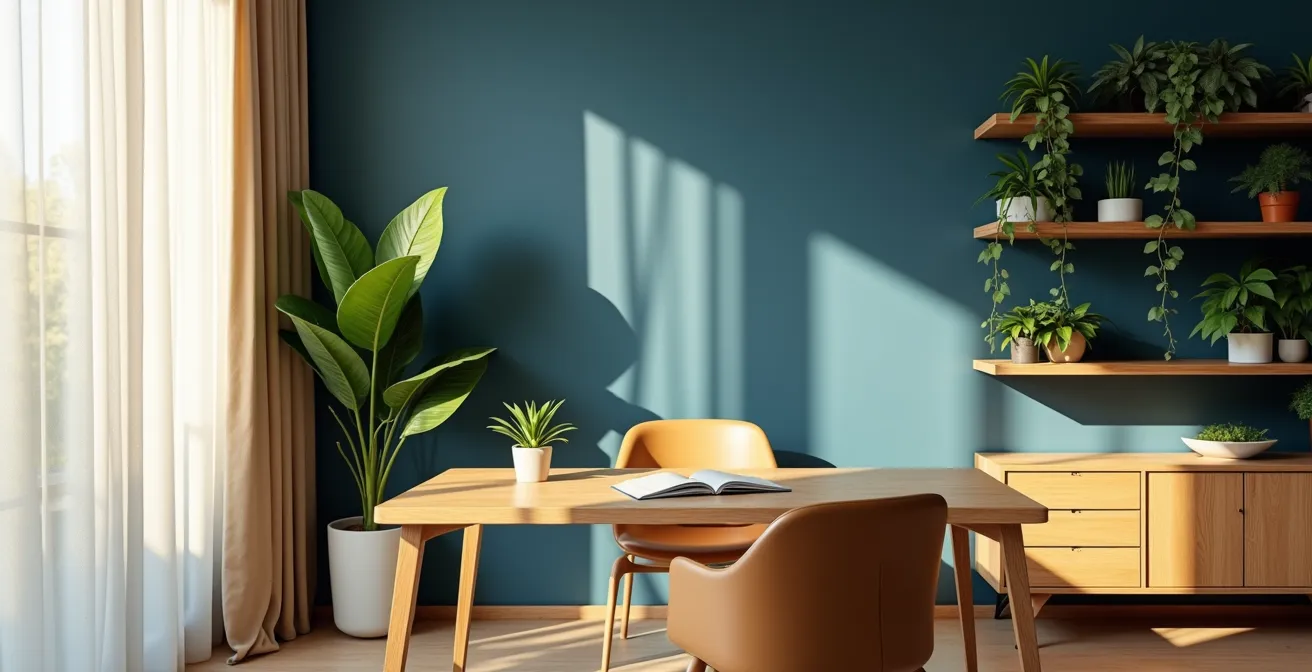
Transforming your home office from a source of fatigue into a catalyst for focus isn’t about trendy decor; it’s about applying the science of cognitive ergonomics.
- Your environment directly influences your brain’s ability to concentrate, with specific colors, textures, and layouts either draining or replenishing your mental energy.
- Strategic use of natural elements (biophilic design) and personalized art can measurably reduce stress hormones like cortisol and improve cognitive function.
Recommendation: Stop treating your office as a passive container and start engineering it as an active tool for deep work by consciously tuning its sensory inputs.
If your home office leaves you feeling drained, uninspired, and lethargic, you are not alone. The common advice is often a superficial checklist: get a new chair, add a lamp, maybe a generic plant. We organize our digital files and our schedules, but we overlook the most influential factor in our daily work experience: the physical space itself. We treat our environment as a backdrop when, in reality, it is an active participant in our cognitive performance. The constant visual noise, the lack of sensory engagement, and the sterile atmosphere are not just aesthetic failings; they are drains on your productivity.
Many guides will suggest painting your walls blue or decluttering your desk, but they rarely explain the potent mechanisms behind this advice. But what if the key wasn’t simply adding objects, but understanding how our brains perceive them? The true lever for a 20% productivity boost—or more—lies not in following trends, but in a deeper discipline: the application of environmental psychology and neuroscience to your workspace. This is about moving beyond simple decoration and into the realm of cognitive ergonomics, where every choice is deliberate.
This guide will deconstruct the science of a high-performance workspace. We will explore how natural textures actively reduce stress, why the right art can serve as a mental reset, and how to build an environment that doesn’t just house your work but actively enhances it. By understanding the ‘why,’ you can design a space that systematically lowers cortisol, boosts focus, and reconnects you with a sense of purpose and calm in your work.
This article provides a complete roadmap for transforming your workspace. The following sections will guide you through the scientific principles and actionable steps needed to engineer an environment that works for you, not against you.
Contents: The Science of a High-Performance Home Office
- Why Adding Natural Textures to Your Decor Reduces Daily Stress?
- How to Style Open Shelving Like a Pro in 3 Simple Steps?
- Original Art vs Mass Prints: Which Is Better for Personalizing a Rental?
- The “Trendy” Decor Mistake That Makes Your Home Look Dated in 6 Months
- When to Swap Textiles to Prepare Your Home for Winter Insulation?
- Why Incorporating Plants in Your Office Boosts Focus by 15%?
- Why a “Straight Cut” Pant Looks Different on Curvy vs Athletic Hips?
- How to Design a Home Environment That Actively Lowers Cortisol Levels?
Why Adding Natural Textures to Your Decor Reduces Daily Stress?
In a work environment dominated by smooth, cold surfaces like glass screens and plastic keyboards, our brains are starved of sensory variety. This sensory monotony contributes to a low-grade, constant state of stress. The solution lies in consciously re-introducing natural textures, a core principle of biophilic design. This isn’t just about making a space “feel” cozier; it’s about providing your nervous system with the complex, non-threatening stimuli it evolved to expect from the natural world.
Consider the tactile difference between a laminate desk and a raw wood surface, or a polyester chair versus one upholstered in linen or wool. These natural materials provide micro-moments of sensory engagement that pull us out of our digital trance and ground us in the physical world. This effect is not merely psychological. Compelling research from Drexel University demonstrates that hands-on engagement with art materials, especially those with texture, can lead to a staggering 75% reduction in cortisol—the primary stress hormone—in just 45 minutes. While you may not be sculpting clay at your desk, the principle holds: interacting with varied, natural textures calms the nervous system.
Incorporating elements like a jute rug, a stone coaster, a raw ceramic pen holder, or even a small piece of driftwood on a shelf introduces this vital sensory tuning. These objects act as subconscious anchors, offering a form of passive mental restoration throughout the day. They break the visual and tactile monotony, providing your brain with a richer, more restorative palette that actively works to lower your baseline stress level.
How to Style Open Shelving Like a Pro in 3 Simple Steps?
Open shelving is often seen as a recipe for clutter, but when approached with intention, it becomes a powerful tool for promoting calm and focus. The mistake most people make is aiming for maximum storage. A professional stylist, however, understands that the goal of open shelving is not storage; it is curated display. The secret is to treat the empty space—the “negative space”—with as much importance as the objects themselves. This visual breathing room is essential for reducing cognitive load.
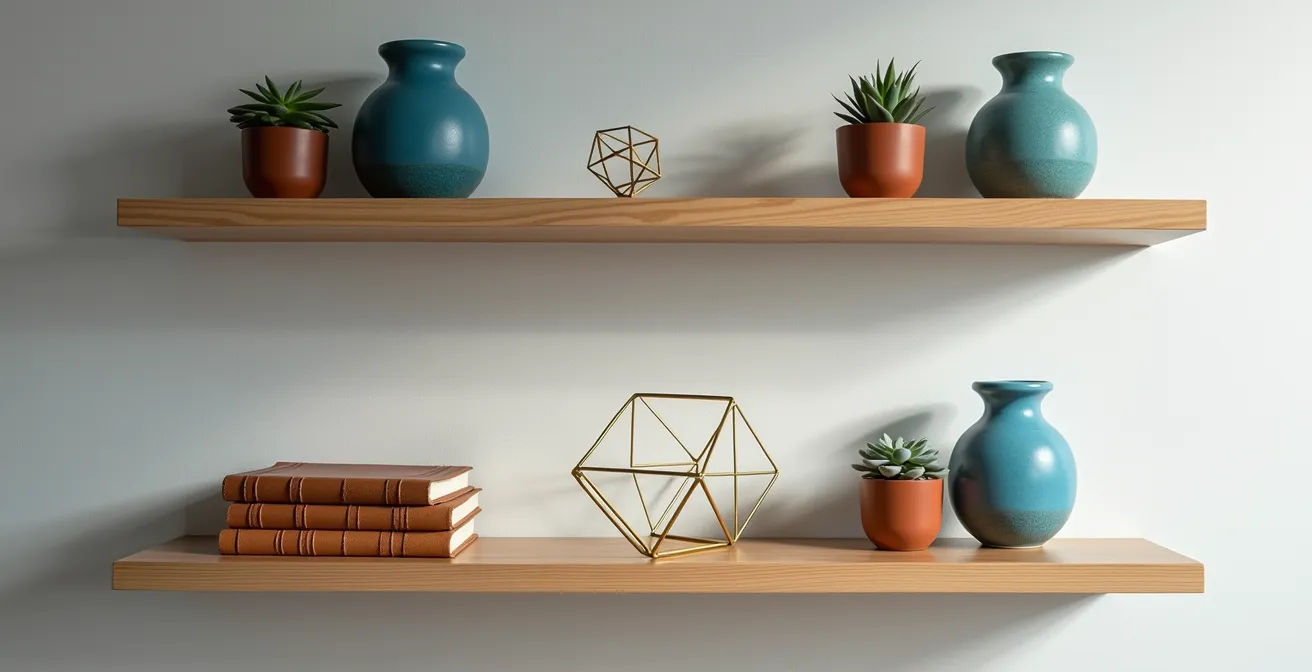
As seen in the composition above, a well-styled shelf is a study in restraint. Here’s how to achieve this look and its cognitive benefits:
- Embrace the 40% Rule: Never fill more than 40-50% of the available shelf surface. This forces you to be selective and guarantees that your items won’t look crowded. The resulting negative space gives each object presence and allows the eye to rest, preventing the feeling of being overwhelmed by visual noise.
- Group by the Rule of Threes (and V): Arrange items in small, asymmetrical clusters of three. Vary the height and shape within each group to create visual interest. For instance, a tall vase, a short stack of books, and a medium-sized sculptural object. Arranging items in a “V” shape or a triangle creates a dynamic yet balanced composition that is naturally pleasing to the brain.
- Commit to a Color & Texture Story: Don’t just place random items. Select a limited color palette (e.g., neutral tones with one or two accent colors like the cerulean blue shown) and a coherent set of textures (e.g., wood, ceramic, paper). This creates a unified visual narrative, turning your shelf from a random collection into a deliberate, artful statement that reinforces a sense of order and calm.
By following these steps, your shelving transforms from a source of clutter into a tool for focus. Each time your gaze falls upon it, you are met not with chaos, but with a quiet, ordered composition that subtly reinforces a state of mental clarity.
Original Art vs Mass Prints: Which Is Better for Personalizing a Rental?
When personalizing a space, especially a temporary one like a rental, the choice between original art and mass-produced prints seems purely aesthetic or budgetary. However, from a psychological perspective, the impact on your well-being and productivity is vastly different. The key distinction lies in the concepts of psychological ownership and narrative value. A mass print is a generic statement; an original piece of art is a personal story.
This sense of personal connection is more than a feeling; it has measurable neurological benefits. As the research team at Mesonart points out in their work on art and stress:
The tactile engagement of running hands over plaster or linen surfaces activates neural pathways more effectively than flat art, offering a 22% greater cortisol drop. The natural materials’ bio-affinity further calms the nervous system.
– Mesonart Research, Neuroscience Insights for Stress Relief Through Art
Original art, particularly pieces with tangible texture, provides a richer sensory input. It invites not just seeing but also imagining the touch, a process that engages more of the brain. The complexity and uniqueness of an original piece serve as an ideal object for “soft fascination,” allowing your mind a momentary, restorative break from directed attention. A glance at a complex painting can be a form of micro-meditation, something a simple, familiar print cannot offer. This distinction is critical for anyone looking to build a truly restorative workspace, as a comparative analysis of their impact makes clear.
| Aspect | Original Art | Mass Prints |
|---|---|---|
| Stress Reduction | 22% greater cortisol drop with textured originals | Standard visual impact only |
| Psychological Ownership | Stronger connection and workspace ownership | Limited personal attachment |
| Mental Reset Capability | Complex pieces serve as meditation points | Less effective for micro-breaks |
| Narrative Value | Unique story provides daily micro-inspiration | Generic imagery lacks personal meaning |
For a remote worker struggling with motivation, the narrative value of an original piece—knowing the artist, the story behind it, or the journey to acquire it—provides a daily dose of micro-inspiration and reinforces a sense of identity within the workspace. In a rental, where major changes are impossible, art becomes the single most powerful tool for claiming the space as your own.
The “Trendy” Decor Mistake That Makes Your Home Look Dated in 6 Months
One of the most common pitfalls in home office design is chasing trends. The “color of the year” or the latest viral decor hack can feel like a quick fix for an uninspiring space, but it often backfires. The core issue is that trends are, by nature, fleeting. A workspace built on the latest fad creates a sense of environmental instability. Your brain thrives on consistency to achieve deep focus; constantly changing your surroundings prevents it from forming the stable associations needed for a productive state of flow.
Furthermore, trendy color schemes are often characterized by bold, high-saturation hues designed to grab attention on social media. While exciting in small doses, an entire room drenched in a vibrant, “in-the-moment” color can create excessive visual stimulation. This constant “shouting” for your attention contributes to visual noise, a form of mental clutter that saps cognitive resources. Research indicates that an overabundance of bright colors can actively hinder productivity by creating a distracting, rather than a supportive, environment.
The goal is not to create a boring or personality-less space, but a timeless one. Instead of adopting an entire trendy palette, a more strategic approach is to build a foundational scheme of proven, calming neutrals (like warm grays, soft whites, or earthy beiges) and introduce trends in small, easily replaceable doses. Think throw pillows, a desk tray, or a single piece of art. This allows you to express personality without sacrificing the psychological stability of your primary environment. A timeless base ensures your office supports your focus for years, not just for a season.
When to Swap Textiles to Prepare Your Home for Winter Insulation?
The transition between seasons is more than a change in temperature; it’s a profound shift in light, mood, and our psychological state. Aligning your home office decor with these seasonal changes, particularly through textiles, is a sophisticated form of sensory tuning that supports both physical comfort and mental well-being. Swapping textiles isn’t just about insulation; it’s about psychologically preparing your mind for the introspective, focused nature of the winter months.
As natural light diminishes in autumn and winter, our brains crave warmth and enclosure. Lighter fabrics like cotton and linen, perfect for summer’s airy feel, can seem cold and sparse in winter. Transitioning to heavier, more textured materials like wool, velvet, or chunky knits provides both literal thermal insulation and a powerful psychological sense of comfort and security—a concept known as “nesting.” The colors of these textiles are equally important. As Johann Wolfgang von Goethe first noted in his color theory, and as modern studies continue to explore, colors have a direct emotional impact. In winter, trading cool summer blues and greens for warmer tones like deep oranges, rich browns (such as “Hat Box Brown”), or muted reds can make a space feel cozier and more comforting, combating the potential for seasonal affective sluggishness.
A phased approach to this transition can make it feel like a natural evolution:
- Early October: Begin by swapping light linen throws and cotton pillow covers for medium-weight fabrics like flannel or brushed cotton.
- Mid-October: Introduce warmer colors through a new rug or upholstered items. This is the time to bring in earthy browns and deep reds that enhance concentration and create a feeling of comfort.
- November: Complete the transition with heavy textiles. A wool blanket draped over your chair or velvet curtains not only adds significant thermal insulation but also absorbs sound, making the room quieter and more conducive to deep work.
–
This seasonal textile swap is a deliberate act of aligning your personal environment with the natural world, creating a workspace that feels supportive, protective, and perfectly attuned to the demands of the season.
Why Incorporating Plants in Your Office Boosts Focus by 15%?
The advice to “add a plant” to your office is one of the most common productivity tips, yet it’s often treated as a mere decorative touch. The reality is far more profound. The presence of plants taps into a deep-seated neurological preference for natural environments, a concept known as biophilia. The performance boost is not just a feeling; it’s a measurable phenomenon. A landmark field study by the University of Queensland found that enriching an office with plants could increase productivity by a remarkable 15%.
So, what is the mechanism behind this boost? It’s a psychological effect called soft fascination. The directed, focused attention required for most work tasks is mentally draining. Staring at a screen, reading a report, or analyzing data depletes our cognitive resources. Natural elements, like the complex patterns of a leaf or the gentle movement of a plant, capture our attention effortlessly and involuntarily. This “soft” fascination allows our directed-attention capabilities to rest and replenish. A quick glance at a plant provides a mental micro-break that is far more restorative than looking at a blank wall or a cluttered desk.

As Marlon Nieuwenhuis from Cardiff University’s School of Psychology, a lead researcher on the study, explained, the findings directly challenge the minimalist, “lean office” philosophy. A sterile environment starves the brain of the restorative stimuli it needs. Introducing plants is not about adding clutter; it’s about providing essential tools for cognitive recovery. The rich green colors are also intrinsically calming to the human eye, reducing stress and promoting feelings of well-being, which are foundational to sustained focus. Even a single, well-cared-for plant can transform an office from a sterile cube into a dynamic, living ecosystem that supports your brain’s natural rhythms.
Why a “Straight Cut” Pant Looks Different on Curvy vs Athletic Hips?
In fashion, it’s a given that a “straight cut” pant will not fit or flatter every body type the same way. What works for an athletic frame may bind on a curvy one, and vice versa. This principle extends directly to home office design: there is no universal “straight cut” or one-size-fits-all solution for a productive workspace. The idea that a single color (like blue) or a single style (like minimalism) is the “best” for everyone ignores the most critical variable: you. Your personality, your work style, and even your innate psychological responses are the equivalent of your body shape; the environment must be tailored to fit them.
Some individuals thrive in a vibrant, visually stimulating environment filled with color and art, finding it energizing. Others require a serene, near-monastic space to achieve deep focus. A University of Texas study highlighted this variance, finding that while bland gray, beige, and white offices induced feelings of sadness in women, men reported similar negative feelings in purple and orange spaces. This underscores the need for deep personalization over prescriptive formulas. As one color psychology expert notes, personal history and association often trump textbook theory.
Although color psychology offers useful insights, your own tastes and work habits should play a significant role in your final decisions. If certain colors have previously helped you concentrate, feel free to use them, even if they don’t align with traditional advice.
Therefore, the process of designing your office should start with self-auditing. Are you an associative thinker who benefits from mind maps and visual cues, or do you need a blank slate to think clearly? Do you work in short, intense bursts, or long, sustained sessions? The answers will dictate whether your ideal space is a vibrant creative lab or a tranquil focus chamber. Just as you choose clothing that fits your unique body, you must design an office that fits your unique cognitive and psychological profile.
Key Takeaways
- Your home office is not a passive container but an active tool that can be engineered for focus using principles of cognitive ergonomics.
- Incorporating natural elements like plants and textures (biophilic design) is scientifically proven to reduce stress hormones and improve concentration.
- Personalization through unique art and a tailored environment is more effective than following generic trends, as it fosters psychological ownership and supports your specific work style.
How to Design a Home Environment That Actively Lowers Cortisol Levels?
We’ve explored the individual components—texture, art, plants, and personalization. Now, let’s synthesize these elements into a holistic strategy for creating an environment that actively works to lower your cortisol levels and promote a state of calm focus. Designing for well-being is not about a single grand gesture but about orchestrating a series of deliberate, science-backed interventions. The goal is to create a multi-sensory sanctuary that signals safety and calm to your nervous system, freeing up your cognitive resources for deep, productive work.
The foundation of this approach is a deep commitment to biophilic design. As research from institutions like Harvard and reports in journals like Nature have consistently shown, exposure to elements that mimic the natural world has a direct, measurable effect on our stress physiology, including reducing heart rate, blood pressure, and cortisol. This goes beyond just adding a plant. It involves a conscious effort to integrate natural light, organic patterns, and sensory richness into every aspect of your workspace.
An environment that lowers cortisol is one that feels both stimulating in a gentle way and profoundly safe. It balances visual interest with visual calm, and it provides zones for both intense focus and mental recovery. By layering these principles, you move from merely decorating a room to truly engineering a high-performance, low-stress ecosystem for your mind.
Your 5-Step Workspace Cognitive Audit
- Points of Contact Audit: List every surface and object you see and touch from your chair. Identify which are cold/artificial (plastic, metal, laminate) versus warm/natural (wood, wool, ceramic). Your goal is to shift the balance toward the latter.
- Light & Shadow Inventory: Observe the light in your office at three different times of day. Where does natural light fall? Where are the harsh shadows from artificial lights? Identify opportunities to maximize natural light exposure and soften artificial sources with shades or diffusers.
- Visual Noise Assessment: Take a photo of your desk and shelves. Anything that doesn’t serve a functional or a deliberate aesthetic purpose is visual noise. Identify three items you can remove or relocate to create more negative space.
- Sensory Richness Check: Is your sensory experience of the room purely visual? List ways to add other senses: the texture of a wool blanket, the scent of an essential oil diffuser (lavender or rosemary), the sound of a small water feature.
- Recovery Zone Plan: Identify one corner or view from your desk. Is it a blank wall or a source of calm (a plant, a piece of art, a window)? Define a “recovery zone” for your eyes and create a simple plan to make it a point of soft fascination.
By systematically applying these principles, you can transform your home office from a space of necessity into your greatest asset for productivity and well-being. Start today by choosing one area to audit and improve.
Frequently Asked Questions About Productive Home Office Decor
Why do trendy colors become dated quickly?
Trendy colors are often tied to fleeting cultural moments and can create “trend fatigue.” It’s wiser to avoid selecting colors just because they’re fashionable; instead, aim for a timeless palette that you personally find calming and that enhances your work environment long-term.
How can I add trends without compromising productivity?
Use trends as accents, not as the foundation. Incorporate a trendy color in small, easily swappable items like a mousepad, a notebook, or a vase. This allows you to feel current without creating the environmental instability that hinders deep focus.
What’s the impact of constantly changing decor?
Environmental instability from frequent, major changes prevents your brain from forming stable spatial associations with your workspace. This mental energy, spent re-adapting to the environment, is energy that is diverted away from your work. A consistent core environment is key for achieving a state of flow.