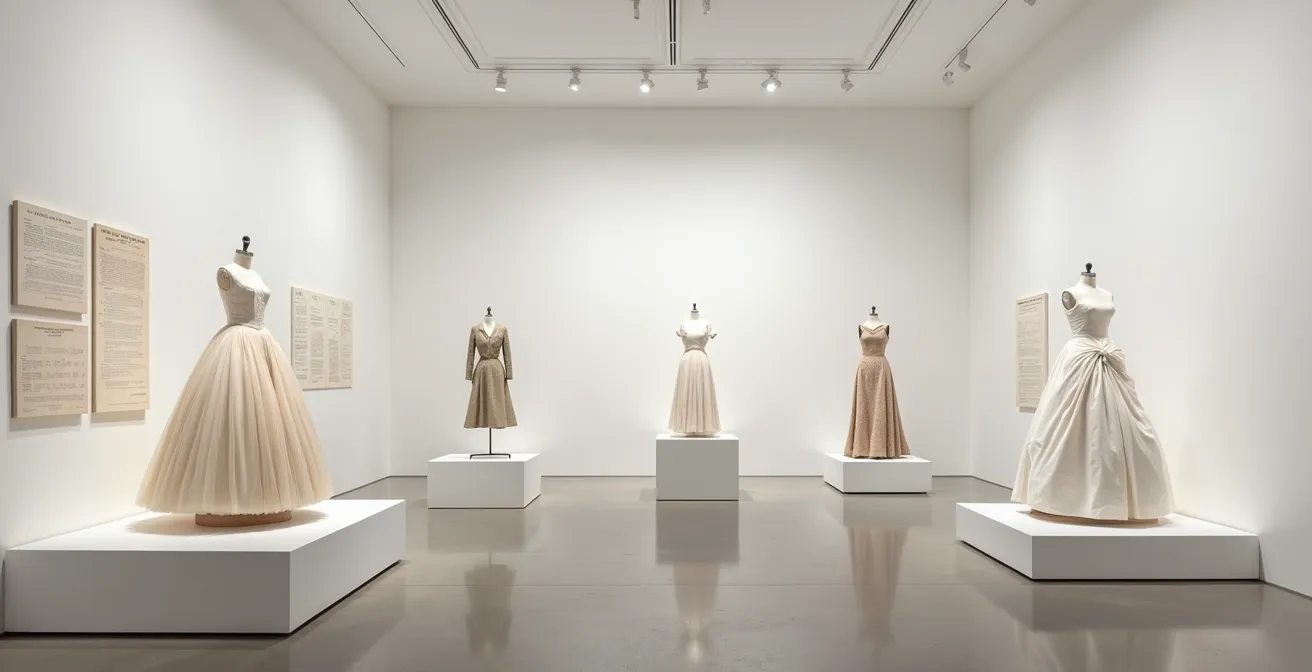
Vintage haute couture is demonstrating superior performance as a tangible asset class, driven by quantifiable intrinsic value and predictable market cycles that disciplined investors can leverage for significant alpha.
- The value of a couture piece is anchored in thousands of hours of irreplaceable master craftsmanship, creating a high barrier to entry and a solid value floor.
- Market timing is crucial, with peak ROI often achieved by acquiring pieces from iconic designers at their creative zenith and divesting following strategic market signals, such as a creative director’s departure.
Recommendation: Approach vintage couture not as a collection but as a strategic portfolio component, applying rigorous due diligence protocols to verify authenticity and asset-preservation techniques to mitigate physical degradation.
In a global market where alpha is increasingly elusive, high-net-worth individuals are perpetually seeking alternative asset classes that offer both diversification and superior returns. While fine art, vintage wines, and classic cars are well-trodden paths, they often come with saturated markets and correlated risks. The common perception relegates fashion to the realm of discretionary spending—ephemeral, trend-driven, and emotionally charged. This view overlooks a powerful, misunderstood, and highly lucrative niche.
But what if the most overlooked tangible asset was, quite literally, hanging in the world’s most exclusive closets? The conversation around vintage haute couture is often dominated by aesthetics and cultural significance. However, when analyzed through the cold, hard lens of an asset manager, it reveals itself to be a structured, tangible asset class with its own metrics for valuation, protocols for due diligence, and cycles for strategic market timing. This is not about buying a beautiful dress; it’s about acquiring a piece of history with a quantifiable return on investment.
This analysis moves beyond the platitudes of “rarity” and “brand heritage.” We will dissect the fundamental drivers of value, from the thousands of hours of labor embedded in a single garment to the forensic details that separate an authentic asset from a worthless liability. We will explore the risk management protocols required to preserve these delicate assets and, most critically, the strategic timing that dictates when to acquire and when to liquidate for maximum ROI. This is a framework for treating vintage couture as a serious component of a diversified, high-performance portfolio.
To fully grasp the mechanics of this unique asset class, this guide breaks down the essential pillars of a successful couture investment strategy. The following sections will provide a detailed analysis, from understanding the intrinsic value of a garment to mastering the logistics of acquiring and protecting these heritage pieces.
Summary: An Asset Manager’s Analysis of Haute Couture as an Investment
- The Hours of Labor Justification: Why One Jacket Costs $30,000?
- How to Store Vintage Silk so It Doesn’t Disintegrate in 10 Years?
- Invite-Only vs Public Access: How to Get on the List for Couture Shows?
- The Stitching Detail That Reveals a Fake Chanel Jacket instantly
- When to Sell a Galliano-Era Dior Piece for Maximum ROI?
- How to Spot Machine-Made Stitches in “Handmade” Textiles?
- How to Rebalance Your Property Portfolio to Minimize Local Risk?
- How to Import High-Value Artisan Furniture Without Customs Nightmares?
The Hours of Labor Justification: Why One Jacket Costs $30,000?
Unlike financial instruments whose value can be abstract, the foundational value of a haute couture garment is anchored in a quantifiable and irreplaceable input: master-level human labor. An investor must first understand this intrinsic value before assessing market value. A price tag that seems astronomical to the uninitiated is, in fact, a direct reflection of unparalleled production costs. According to luxury fashion analysis, a simple couture suit requires 150 hours of work, while elaborate gowns can take over 1,000 hours, often involving a team of four to ten specialized artisans—from feather workers (plumassiers) to embroiderers (brodeurs)—working on a single piece.
This immense labor input creates a fundamental value floor. It is not an arbitrary price set by a brand, but a calculation based on the time of the world’s most skilled craftspeople. This principle is what separates true couture from luxury ready-to-wear and provides a tangible basis for its long-term value appreciation. The following data provides a clear framework for understanding this direct correlation between production time and initial asset cost.
| Garment Type | Starting Price | Peak Price | Production Hours |
|---|---|---|---|
| Basic Couture Suit | $20,000 | $50,000 | 150 hours |
| Evening Gown | $50,000 | $300,000 | 700-1,000 hours |
| Wedding Dress | $100,000 | $1,000,000+ | 1,000+ hours |
However, labor hours alone do not guarantee a positive return. The strategic layer of value comes from the creative genius directing that labor. As Kate Osborn of Kerry Taylor Auctions astutely points out, this is where an investor’s knowledge creates alpha:
The pieces worth investing in are those by the best designers at the peak of their careers. For example, Christian Dior Paris couture from the 1950s, Balenciaga from the 1960s, Yves Saint Laurent in the mid-1960s and seventies
– Kate Osborn, Kerry Taylor Auctions
How to Store Vintage Silk so It Doesn’t Disintegrate in 10 Years?
Acquiring a high-value tangible asset is only half the equation; preserving its condition is paramount to protecting its capital value. For vintage textiles, particularly delicate materials like silk, improper storage is the single greatest risk to your investment. Unlike stocks, which exist digitally, a couture garment is subject to physical degradation from light, humidity, and temperature fluctuations. Effective asset preservation is an active risk management strategy, not passive storage.
The core of this strategy lies in environmental control. According to the Canadian Conservation Institute’s preservation guidelines, optimal storage conditions are 15-25°C and 45-55% relative humidity, with minimal fluctuation. This rules out common storage areas like attics or basements, which experience extreme temperature swings, and necessitates a dedicated, climate-controlled environment. This is not a mere suggestion; it is a critical requirement to prevent the microscopic fiber breakdown that leads to catastrophic value loss. An asset that is not in pristine, museum-quality condition will fail to achieve its peak market value upon liquidation.
To translate these principles into a concrete protocol, a systematic approach is necessary. The following checklist outlines the non-negotiable steps for museum-grade asset preservation, ensuring your investment remains in optimal condition for decades.
Action Plan: Museum-Grade Asset Preservation Protocol
- Environmental Control: Maintain a stable environment with consistent temperature (15-25°C) and relative humidity (45-55%), avoiding attics, basements, or garages.
- Archival Materials: Use only acid-free archival boxes and tissue paper to prevent chemical degradation and color transfer. A typical investment of $25-$100 per box is a negligible cost to protect a five or six-figure asset.
- Pre-Storage Preparation: Ensure the garment is professionally and gently cleaned before storage. For silks, use cool water and specialized mild detergents. For silk blends, lightly brush the fabric to lift the nap.
- Protected Breathing: Store fabrics in archival boxes that allow them to breathe, avoiding plastic containers which can trap moisture and accelerate mold growth.
- Regular Inspection: Schedule and conduct periodic checks on your vintage assets, especially older silks, to identify any early signs of stress or degradation, allowing for timely intervention.
Invite-Only vs Public Access: How to Get on the List for Couture Shows?
In the world of ultra-luxury assets, access is a currency in itself. Unlike public stock markets, the primary market for haute couture—the biannual shows in Paris—is an opaque, invite-only ecosystem. Gaining entry is not a matter of purchasing a ticket; it is a strategic process of building a demonstrable relationship with the couture houses. This exclusivity acts as a significant barrier to entry, protecting the value and prestige of the assets for those within the circle.
From an investment perspective, securing an invitation is the first step toward acquiring assets at their source. The front rows are reserved for established clients who have a history of significant acquisitions. New entrants must build their profile by first becoming a key client in the brand’s high-end ready-to-wear or fine jewelry departments. This demonstrates both financial capacity and a genuine commitment to the brand’s universe. It is a calculated, multi-year strategy to signal your seriousness as a collector and investor.
This dynamic transforms the act of purchasing into a form of strategic positioning. As Zarina Rasueva, a prominent couture client, explains to Harper’s Bazaar Arabia, the investment is twofold:
By investing in couture, you invest in your relationship with the couture houses. When buying Chanel and Dior, you become part of their history. Their incredibly attentive attitude and exclusive approach to you as a client is certainly part of the ritual called ‘couture’
– Zarina Rasueva, Harper’s Bazaar Arabia
This “relationship alpha” provides privileged access to the most desirable pieces, expert advice from the sales directors, and entry into an exclusive global community of collectors. It’s a network that yields information and opportunities unavailable to the outside world.
The Stitching Detail That Reveals a Fake Chanel Jacket instantly
For any tangible asset, authentication is the cornerstone of due diligence. In the high-stakes world of vintage couture, a convincing counterfeit is a total loss of capital. A sophisticated investor must develop a forensic eye for the minute details that machines and counterfeiters cannot replicate. With Chanel jackets, one of the most liquid and sought-after assets in this class, the authentication process often comes down to a quantifiable metric: stitch density.
While a novice might look at logos or hardware, an expert examines the construction. As authentication specialists reveal, a key differentiator is the number of stitches per inch in the quilting. Authentic Chanel has at least 10 stitches per inch, while replicas typically have only 8-9 stitches. This subtle difference reflects the higher quality control and superior machinery used by the maison, creating a tighter, more durable, and more luxurious finish. It is a simple, measurable data point in your due diligence protocol.
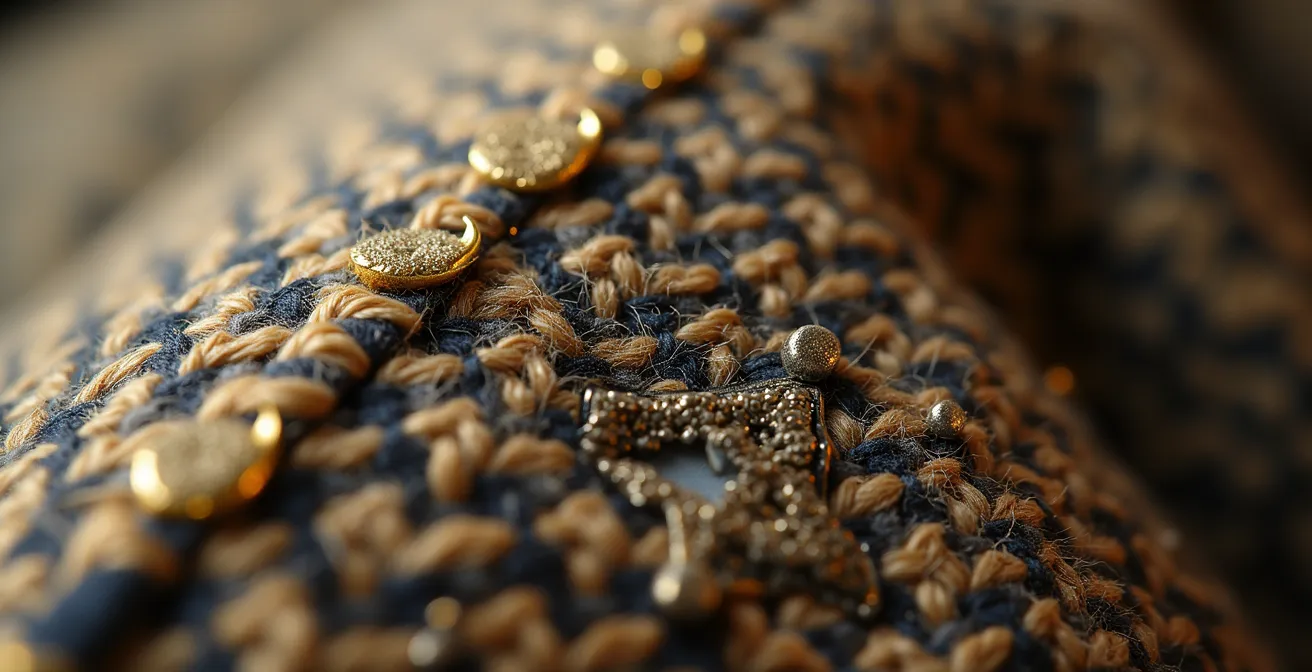
Beyond stitch count, the truly inimitable details are those executed by hand, as they contain the slight, organic imperfections that prove human artistry. These are the elements that a machine, programmed for uniformity, simply cannot reproduce. This is where a trained eye becomes an investor’s most valuable tool.
Case Study: Forensic Stitch Analysis in Authentication
An analysis of authentic Chanel couture jackets reveals that key structural elements like buttonholes and pocket attachments are entirely hand-sewn with invisible stitching that appears to float on the fabric. Counterfeit jackets, even high-quality ones, inevitably betray themselves with machine stitching, which leaves a visible, uniform top-stitch. Furthermore, the signature chain weight, meticulously hand-sewn into the inner hem of an authentic jacket to ensure a perfect drape, is a functional and aesthetic detail consistently absent from copies. The presence of this chain is one of the most definitive markers of authenticity, serving as a final, non-negotiable checkpoint in the verification process.
When to Sell a Galliano-Era Dior Piece for Maximum ROI?
Just as in equity markets, successful investing in vintage couture depends not only on what you buy, but critically, on when you sell. Market timing in this asset class is influenced by a unique set of factors, including cultural moments, museum exhibitions, and, most importantly, the career trajectories of its star designers. An investor must learn to read these signals to execute a sale for maximum return on investment.
The appreciation potential of these assets can be dramatic, far outstripping traditional market benchmarks. For instance, Kerry Taylor Auctions data demonstrates that a Charles James evening dress increased 65% in value in just two years, escalating from $29,000 to $49,450. This is not an anomaly but an illustration of the alpha generated when exceptional craftsmanship meets heightened market demand. The key is to identify the catalysts that trigger such rapid value acceleration.
One of the most reliable signals for a value spike is a change in creative direction at a major fashion house. This is a form of “lifecycle arbitrage” unique to this asset class. As Zarina Rasueva highlights, this is a predictable pattern:
The most profitable investments in vintage couture are purchases of designer pieces created during the designer’s creative peak. When a highly beloved designer departs the fashion house, such as Phoebe Philo from Celine or Tom Ford from Gucci, such pieces have worldwide appeal and would only increase in value with years
– Zarina Rasueva, Harper’s Bazaar Arabia
The departure of an iconic designer like John Galliano from Dior instantly crystallizes his tenure, turning his creations from contemporary fashion into a finite collection of historical artifacts. This creates a surge in demand from collectors and museums seeking to acquire a piece of that celebrated era, providing a prime liquidation window for the savvy investor.
How to Spot Machine-Made Stitches in “Handmade” Textiles?
The fundamental premise of haute couture’s value is its irreplicable human touch. The ability to distinguish between true hand-craftsmanship and sophisticated machine work is a crucial due diligence skill. While a machine produces stitches with flawless, mechanical uniformity, a master artisan’s hand produces stitches with micro-variations in tension and spacing. This “perfect imperfection” is not a flaw; it is the signature of authenticity and the source of the garment’s superior drape and feel.
A machine lockstitch, visible on the reverse side of a fabric, creates two interlocking threads with rigid, uniform tension. This can create slight puckering and a stiffness that a handmade garment avoids. In contrast, a hand-sewn seam often uses a single thread in a series of loops, allowing the fabric to move and settle more organically. An investor must train their eye—and hand—to detect this tactile difference. The feel of a hand-sewn seam is often softer and more fluid against the skin.
This distinction becomes most apparent in complex construction techniques that are physically impossible for a machine to execute. These techniques are a definitive hallmark of true couture and a key focus area during the authentication process.
Case Study: The ‘Eased Dart’ Authentication Method
Expert textile authentication often focuses on techniques like the ‘eased dart,’ a method used to shape fabric around the body’s curves. A machine-stitched dart is created by folding and sewing a wedge of fabric, resulting in a sharp, stitched line with uniform tension. In contrast, a hand-sewn ‘eased dart’ is created by gathering and manipulating the fabric with thousands of tiny, almost invisible hand stitches that control the fullness without a hard seam. The result is a garment that drapes with an organic, sculpted quality that a machine cannot replicate. This difference is both visual and tactile, representing a level of artistry that fundamentally underpins the garment’s value as a heritage asset.
How to Rebalance Your Property Portfolio to Minimize Local Risk?
A core tenet of sophisticated portfolio management is diversification to mitigate concentrated risk. High-net-worth portfolios are often heavily weighted in asset classes like real estate, which are inherently illiquid and exposed to localized economic and political risks. Vintage haute couture, as a globally traded tangible asset, offers a powerful instrument for strategic diversification and risk hedging.
The value of a couture piece is largely decorrelated from regional property markets or domestic equity fluctuations. Its market is international, comprised of a passionate and well-capitalized global collector base. This provides a crucial buffer. A downturn in the New York commercial real estate market, for example, has virtually no impact on the auction value of a 1960s Balenciaga gown in Paris or Hong Kong. As the iconic Hermès Birkin bag has shown, some luxury assets can be remarkably resilient; its value has historically made it a ‘safer’ investment than the stock market. According to analysis published by Arts & Collections, the value of Birkin handbags has increased over 500 percent in the last 35 years.
Furthermore, the haute couture market itself is projected to have stable, long-term growth. Independent market research indicates the Haute Couture Market, valued at $1.3 billion in 2024, is expected to reach $1.7 billion by 2034, growing at a steady CAGR. By allocating a percentage of a portfolio to this asset class, an investor can introduce a source of return that is not just high-potential, but also structurally insulated from the local risks that threaten more traditional investments. It is a strategic rebalancing tool, transforming a passion asset into a functional portfolio hedge.
Key Takeaways
- Intrinsic Value Is Quantifiable: The high price of haute couture is not arbitrary; it’s a direct function of 150 to over 1,000 hours of irreplaceable master craftsmanship, providing a solid, labor-based value floor for the asset.
- Authenticity Is a Forensic Science: Due diligence goes beyond logos. Verifying an asset requires measurable technical checks, such as ensuring a minimum of 10 stitches per inch on Chanel quilting and identifying hand-sewn details like ‘eased darts’ that machines cannot replicate.
- ROI Is Driven by Strategic Timing: Maximum returns are achieved by understanding market cycles unique to couture. The departure of a celebrated creative director (e.g., Galliano from Dior, Philo from Celine) creates a finite collection and a predictable spike in demand, signaling a prime opportunity for liquidation.
How to Import High-Value Artisan Furniture Without Customs Nightmares?
The final, and often most underestimated, phase of acquiring a high-value heritage asset like vintage couture is the physical logistics of importation. Whether purchasing from a Parisian auction house or a private collector in Milan, navigating international customs is a complex process fraught with potential for costly delays, duties, and even seizure if not handled with expert precision. Treating this as a mere shipping task, rather than a specialized logistical operation, is a critical error.
The key to a seamless process is meticulous documentation and the use of correct legal frameworks. An asset of this nature is not a standard piece of clothing; it is often classified as a ‘collector’s item of historical interest’. This classification, if properly documented, can significantly alter its customs treatment. The process requires a proactive approach, building a dossier for the asset before it ever leaves its country of origin. This includes establishing clear provenance, authenticating its age and creator, and documenting any conservation work.
For a sophisticated investor managing a global portfolio of tangible assets, establishing a relationship with a specialized customs broker is non-negotiable. These experts are familiar with the specific Harmonized System (HS) codes for heritage items and the legal instruments, like the ATA Carnet, that allow for temporary importation without duties for purposes like exhibitions or evaluation. A successful import strategy involves these key steps:
- Provenance and Authentication: Obtain detailed provenance documentation, authenticated by recognized experts or the original maison.
- Correct Classification: Research and use the correct Harmonized System (HS) codes, specifically those for ‘collectors’ items of historical or ethnographic interest’ (Chapter 97), not standard apparel codes.
- Regulatory Compliance: Ensure full compliance with international regulations like CITES (Convention on International Trade in Endangered Species) if the garment includes materials like exotic skins, feathers, or ivory.
- Temporary Importation: For non-permanent transfers, consider using an ATA Carnet, which acts as a passport for goods, eliminating the need to pay import duties and taxes.
- Specialized Brokerage: Engage a customs broker who specializes in art, antiques, and high-value heritage assets. Their expertise is an essential component of risk mitigation.
By viewing haute couture through this financial and operational lens, it becomes clear that this is far more than a passion pursuit. It is a demanding but potentially highly rewarding asset class that calls for the same rigor, discipline, and strategic foresight as any other component of a high-performance investment portfolio. The next logical step for a serious investor is to begin identifying potential acquisition targets and initiating the due diligence process.